10 Best CRMs for WooCommerce 2026: Pricing, Features, and Honest Verdicts
E-commerce is evolving, and relying purely on basic email marketing won’t cut it in 2026. If you’re running a WooCommerce store, you need a CRM that understands order data, predicts customer behavior, and recovers abandoned revenue.
But here’s the problem: the market is flooded with marketing tools that range from expensive, bloated SaaS platforms to barebones WordPress plugins. Do you need predictive analytics, or just a solid abandoned cart flow? Do you want to own your customer data, or are you okay with syncing it to the cloud?
I’ve researched the top 10 WooCommerce CRMs currently dominating the landscape in 2026. Let’s break down their features, pricing, and the real pros and cons of each. So, store owners can pick the best CRM that actually fits your store.
1. CRMlytics
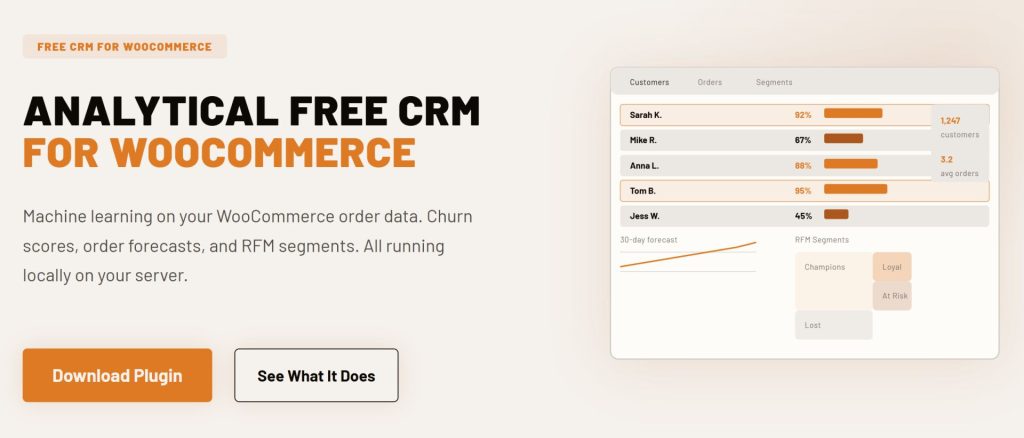
CRMlytics takes a completely different approach. Instead of focusing heavily on workflow builders, it is a native CRM built specifically for WooCommerce stores. It uses predictive modeling (specifically the BG/NBD statistical model) to tell you exactly who is about to churn and when a customer is likely to order next. The best part? It runs entirely on your own server, meaning you own your data.
Key Features
- Store Performance Dashboard: See revenue, active users, conversion rates, and how many customers are at risk of churning in one place, without switching tabs.
- Full Customer Profiles: Every customer’s page holds custom fields, notes, tags, email history, and a complete interaction timeline.
- Color-coded Tags & Smart Tags: Apply color-coded labels manually or let the plugin add and remove them automatically based on customer behavior, like crossing a spending threshold.
- Customer Search & Filter: Find any customer quickly by name, email, tag, health score, order count, or custom field.
- Manual Activity Logging: Log phone calls, support notes, and customer feedback right on a customer’s profile, where it shows up in the timeline next to orders and emails.
- Custom Segments: Build live customer groups by stacking rules like total orders, average order value, health score, purchase dates, and tags, then save them for campaigns.
- Built-in Email Campaigns: Send targeted emails to individuals, segments, or tagged groups from inside the plugin using your existing WordPress mail setup and five included templates.
- Email Click Tracking: Every link click gets logged and fed back into the customer’s timeline, so engagement data builds up with every send.
- Onboarding Wizard: A guided setup runs on first activation and has you looking at insights in under two minutes, no API keys or separate accounts required.
- 1-Click CSV Export: Export any customer list or saved segment to a CSV file in seconds, ready for Mailchimp, ad platforms, or your own spreadsheet.
- Historical Data Compatibility: Scores populate within minutes from your existing WooCommerce order history when you activate the plugin, no waiting for new orders to build up.
- BG/NBD-Powered Predictions: The BG/NBD model is a statistical method for predicting repeat purchases, calibrated to your store’s actual buying patterns.
- Predictive Churn Risk: Health scores flag customers in real time who are slipping away before they are gone.
- Expected Future Orders: Estimates the number of orders a customer will place in the next 30, 90, and 180 days.
- Automated RFM Scoring: Automatically ranks customers by Recency, Frequency, and Monetary value.
- Unified Timeline: Combines order changes, email clicks, and manual notes into one customer view.
- 100% Data Sovereignty: Everything lives in your WordPress database, no third-party syncing.
Pricing
- Free: Available completely free on the WordPress repository. (No paid tiers or contact limits).
Pros
- Gives you enterprise-level predictive analytics (like Klaviyo) without the SaaS price tag.
- You own your data entirely.
- Extremely cost-effective for large lists since there are no contact-based fees.
Cons
- Lacks a visual, drag-and-drop workflow builder for complex email automation.

2. Klaviyo
Klaviyo remains the heavyweight champion of e-commerce marketing. It’s an operational CRM that excels in revenue attribution and deeply personalized email marketing and SMS flows. If email drives a massive chunk of your revenue, Klaviyo’s predictive analytics and segmentation are hard to beat.
Key Features
- Best-in-Class Segmentation: Build lists based on highly specific behaviors (e.g., “purchased X but not Y in the last 30 days”).
- Predictive Analytics: AI tools predict customer lifetime value (CLV) and churn risk.
- Pre-built E-commerce Flows: Instant templates for abandoned carts, post-purchase, and win-backs.
- Revenue Attribution: Clear reporting on exactly how much money each email or SMS generated.
Pricing
- Free Tier: Up to 250 active profiles and 500 emails/month.
- Paid Plans: Starts at $20/month for 500 profiles. Scales steeply based on active profiles (e.g., ~$150/month for 10k contacts; ~$700/month for 50k contacts).
Pros
- Unmatched integration with WooCommerce order data.
- SMS and email are managed in one unified platform.
- The revenue attribution reporting is incredibly accurate and actionable.
Cons
- Pricing scales aggressively and can become very expensive as your list grows.
- Inactive profiles still count toward your billing unless aggressively cleaned.
3. ActiveCampaign
ActiveCampaign sits in the sweet spot between a traditional CRM for managing customer relationships and a marketing automation powerhouse. While Klaviyo is built strictly for e-commerce, ActiveCampaign is better if you have a B2B component, need sales pipelines, or want complex, branching automation logic.
Key Features
- Advanced Visual Automation: The best workflow builder in the business for complex conditional logic.
- Built-in CRM & Pipelines: Manage sales deals and B2B clients alongside your retail customers.
- Predictive Sending: Analyzes individual habits to send emails at the exact time a user is most likely to open.
- Multi-Channel: Email, SMS, and site messaging in one hub.
Pricing
- Starter Plan: Starts at $15/month for 1,000 contacts.
- Plus Plan (Includes CRM): Starts at $49/month for 1,000 contacts. (Roughly $259/month at 50k contacts).
Pros
- Significantly cheaper than Klaviyo at scale (often 30-40% less for large lists).
- The visual automation builder is incredibly flexible.
- Excellent for stores that also require B2B sales pipelines.
Cons
- The e-commerce segmentation isn’t quite as deep or intuitive as Klaviyo’s.
- The interface can feel overwhelming due to the sheer volume of features.
4. FunnelKit Automations
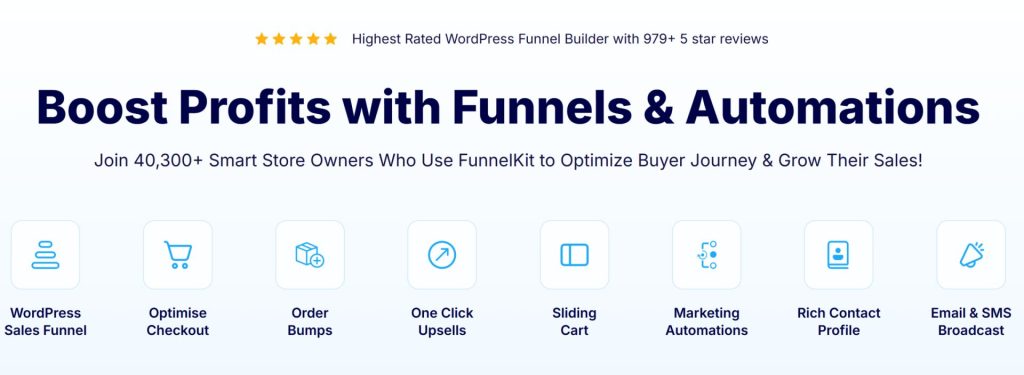
FunnelKit Automations (formerly part of WooFunnels) is a self-hosted WordPress plugin that turns your WooCommerce dashboard into an operational CRM. It’s purpose-built for WooCommerce, meaning the integration is flawless, and it allows you to handle everything from cart recovery to post-purchase sequences without paying a monthly SaaS fee.
Key Features
- Deep Order Sync: Contact profiles auto-populate with order history and total spend.
- Abandoned Cart Recovery: Pre-built, highly effective cart recovery workflows.
- Visual Automation Builder: Build sequences directly inside WordPress.
- A/B Testing: (When bundled with their Funnel Builder) Test checkout flows and upsells.
Pricing
- Lite: Free version available.
- Basic: $99.50/year (1 site).
- Professional (Full Suite): $249.50/year.
Pros
- Fantastic value, no monthly fees or contact limits.
- Keeps all your data on your own server.
- The workflow builder is very intuitive for WordPress users.
Cons
- Lacks the deep predictive analytics of SaaS competitors.
- Sending emails requires you to set up your own SMTP service (like Amazon SES or SendGrid).
5. FluentCRM
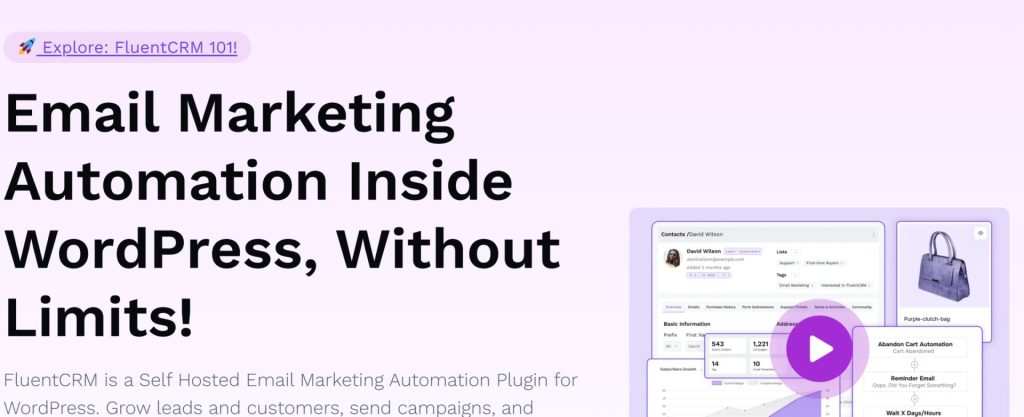
FluentCRM is another native WordPress plugin that has gained massive popularity for its clean interface and unlimited contact pricing. It’s an operational CRM that focuses heavily on email marketing and segmentation right from your WordPress dashboard.
Key Features
- 360° Contact Overview: See emails, purchase history, and form submissions in one place.
- Unlimited Contacts: You only pay for the software, not the size of your list.
- Smart Segmentation: Tag and segment users based on WooCommerce purchase behavior.
- Email Sequences: Build automated welcome series and email campaigns easily.
Pricing
- Free Version: Covers basic lists, tags, and campaigns.
- Pro Version: $129/year for 1 site (often discounted to ~$103/year).
Pros
- Extremely budget-friendly, especially for large lists.
- Flawless integration with WooCommerce and other WP plugins (like Fluent Forms and LearnDash).
- Data stays 100% on your server.
Cons
- Server performance can affect the plugin’s speed if you have a massive database.
- You still need to configure and manage a third-party SMTP provider for reliable email delivery.
6. Drip
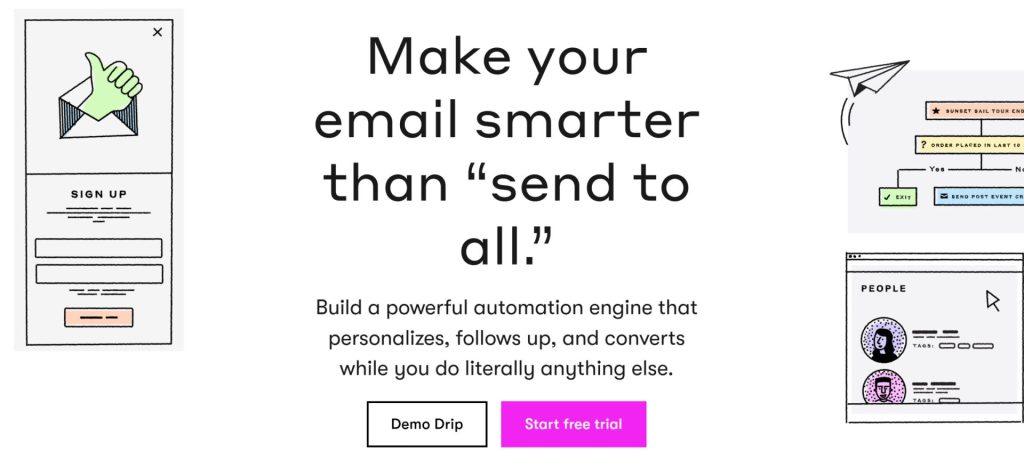
Drip is a marketing automation platform built entirely around e-commerce. It positions itself as a friendlier, slightly more accessible alternative to Klaviyo, focusing heavily on behavioral segmentation and visual workflows for direct-to-consumer (DTC) brands.
Key Features
- Dynamic Segmentation: Filter by purchase history, RFM (Recency, Frequency, Monetary), and browsing behavior.
- Visual Workflow Builder: Easy-to-use canvas for building e-commerce automations.
- Onsite Campaigns: Built-in pop-ups, bars, and embeds to capture leads.
- Single Feature Set: Every pricing tier gets access to all features.
Pricing
- Starts at $39/month: Up to 2,500 contacts with unlimited emails.
- Scales: ~$154/month for 10k contacts; ~$699/month for 50k contacts.
- No free plan (14-day trial only).
Pros
- You don’t have to upgrade to a higher tier just to unlock advanced features.
- The visual workflow builder is arguably easier to learn than Klaviyo’s.
- Deep, reliable integration with WooCommerce.
Cons
- The $39 entry point is steep for brand-new stores.
- Pricing scales aggressively past 5,000 contacts.
- No built-in SMS capabilities (email marketing only).
7. Brevo (formerly Sendinblue)
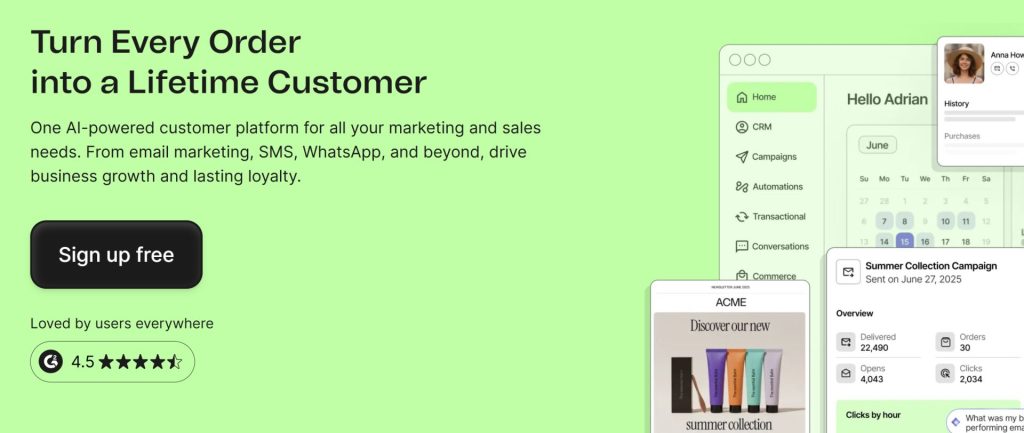
Brevo is the ultimate budget-friendly all-in-one platform. Its biggest differentiator is that it charges based on emails sent, not the number of contacts in your database. This makes it incredibly cheap for stores with massive lists that don’t email every single day.
Key Features
- Multi-Channel: Email, SMS, WhatsApp, and live chat in one platform.
- Transactional Emails: Built-in SMTP for order confirmations and shipping updates.
- Unlimited Contacts: Store as many profiles as you want for free.
- Basic E-commerce Automations: Cart recovery and welcome sequences.
Pricing
- Free Plan: 300 emails/day to unlimited contacts.
- Starter: $9/month for 5,000 emails.
- Business: $18/month (unlocks automation and landing pages).
Pros
- The per-email pricing model can save you 60-80% compared to Klaviyo or ActiveCampaign if you have a large list.
- Transactional emails are included out of the box.
- Great value for small businesses that need multiple communication channels.
Cons
- The WooCommerce integration is shallow compared to dedicated e-commerce CRMs.
- The jump to their “Professional” tier (for advanced features) is a steep $499/month.
- Deliverability can sometimes be inconsistent on the lower tiers.
8. Metorik
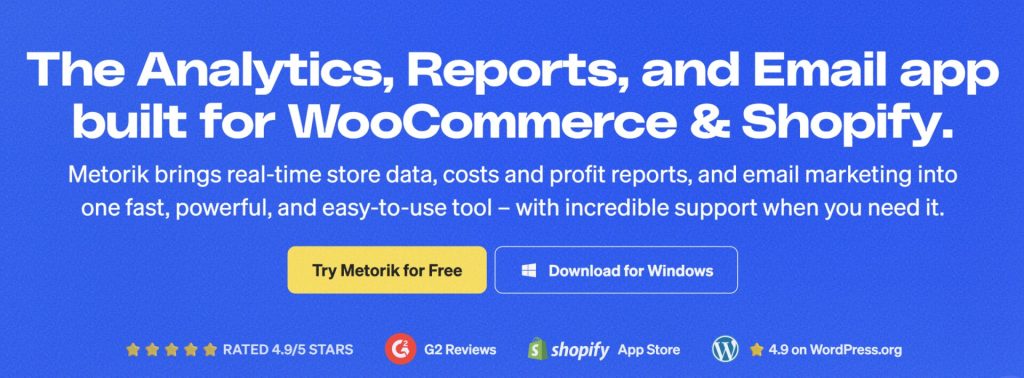
Metorik isn’t a traditional email-sending CRM; it’s a powerful e-commerce analytics and reporting platform that plugs into WooCommerce. It acts as an external dashboard to help you segment customers, track profits, and understand retention, though it does offer an automated email add-on.
Key Features
- Deep Analytics: Revenue, customer reports, cohort analysis, and product analytics.
- Advanced Segmentation: Filter customers by hundreds of different metrics (e.g., finding your “whales” vs. “zombies”).
- Profit Tracking: Accurately tracks COGS (Cost of Goods Sold) and net margins.
- Metorik Engage (Add-on): Send automated emails based on your advanced segments.
Pricing
- Small: $20/month (up to 100 orders/month).
- Medium: $50/month (up to 500 orders/month).
- Large: $100/month (up to 2,500 orders/month).
- (Engage email add-on costs extra).
Pros
- The UI is incredibly fast and beautiful compared to the native WooCommerce dashboard.
- The segmentation and cohort analysis are top-tier.
- One subscription covers multiple stores.
Cons
- Pricing is based on order volume, so your bill increases as you succeed, regardless of contact size.
- It’s an analytics tool first; the email marketing automation is an add-on, not the core focus.
9. HubSpot
HubSpot is the enterprise-grade behemoth of the CRM world. It offers a massive ecosystem that unifies marketing, sales, and customer service. However, it is fundamentally a B2B platform that has been adapted for e-commerce, rather than a purpose-built retail tool.
Key Features
- All-in-One Ecosystem: Marketing, Sales, and Service Hubs talk to each other seamlessly.
- Robust CRM: Detailed contact records with timeline tracking and lead scoring.
- Helpdesk Integrations: Manage customer support tickets directly tied to contact records.
- Massive App Marketplace: Connects with almost anything, including WooCommerce.
Pricing
- Free CRM: Excellent basic contact management.
- Starter: ~$20/month.
- Professional: The infamous “pricing cliff” jumps to $890/month (plus a mandatory $3,000 onboarding fee).
Pros
- The best UX and interface in the industry.
- Incredible for businesses that have a mix of B2B sales, wholesale, and direct retail.
- The free CRM tier is genuinely useful for managing contacts.
Cons
- It is not purpose-built for e-commerce (lacks native, deep product-based triggers like browse abandonment).
- The pricing scales absurdly fast at the Professional tier.
- Syncing WooCommerce data often requires a third-party connector plugin (like MakeWebBetter).
10. Groundhogg
Groundhogg is a self-hosted WordPress CRM built for developers, agencies, and businesses that demand total control. It is open-source (GPL licensed), meaning you own the code and your data, making it a great choice for privacy-conscious stores.
Key Features
- Visual Flow Editor: Modern drag-and-drop builder for automated funnels.
- Flat-Rate Pricing: Unlimited contacts and emails.
- Sales Pipeline: Includes basic deal tracking and sales stages.
- White-Labeling: The Agency plan allows you to rebrand the CRM for clients.
Pricing
- Basic: $20/month (billed annually).
- Pro: $50/month (Includes WooCommerce integration and SMS).
- Agency: $100/month (White-labeling and partner certification).
Pros
- You own the software and the data completely.
- Grandfathered pricing, your renewal price never goes up.
- Excellent commission program for agencies.
Cons
- The interface, while improved, still feels a bit more “developer-focused” than FluentCRM or FunnelKit.
- Setting up SMTP and ensuring high deliverability is entirely on your shoulders.
The Verdict
For store owners, choosing the Best CRM for WooCommerce in 2026 depends entirely on your business model and budget:
- If you want enterprise-grade predictive analytics without SaaS fees: Go with CRMlytics. It’s free, native, and tells you exactly who is churning.
- If email drives a massive percentage of your revenue and you want the best ROI reporting: Bite the bullet on price and use Klaviyo.
- If you want to own your data and want a great visual workflow builder in WordPress: FunnelKit Automations is the top self-hosted choice.
- If you have a massive email list but don’t send emails every day: Brevo will save you a small fortune with its per-email pricing.
- If you have a B2B sales team alongside your WooCommerce store: ActiveCampaign provides the best balance of automation and pipeline management.
How successful stores actually operate: two tools, not one
Most growing e-commerce businesses don’t rely on a single CRM. They run two specialized tools side by side: one for analytics, one for execution.
An operational CRM handles what to send. Visual email sequences, cart recovery workflows, marketing automation. But it doesn’t tell you who to send it to or why. That requires an analytical CRM running predictive models on your order data.
This is standard practice at scale. Klaviyo pairs with Metorik. ActiveCampaign pairs with Google Analytics. HubSpot pairs with its own reporting add-ons. The pattern is the same everywhere: one tool identifies the segment, the other acts on it.
For WooCommerce stores that want this setup without the SaaS price tag, CRMlytics handles the intelligence layer: churn risk, RFM segments, order forecasts, all running locally on your server. FunnelKit Automations handles the execution: workflows, cart recovery, email sequences. CRMlytics identifies who’s at risk. FunnelKit triggers the retention campaign. Your customer data never leaves WordPress.