7 Best Free CRM for WooCommerce Stores in 2026
Most WooCommerce store owners do not realize how much money they are losing to silent churn. The numbers are rough: the average ecommerce churn rate sits around 77 percent annually, which means more than three-quarters of customers never come back after their first purchase. At the same time, repeat customers make up only 21 percent of a typical customer base but generate 44 percent of total revenue. If you are running a WooCommerce store without a system to track who is slipping away, you are leaving money on the table every single month.
Finding the best free CRM for WooCommerce matters because of those numbers. A CRM turns a raw list of order numbers into a clear picture of your actual customers. You see who buys often, who has not purchased in months, and who is likely to stop buying altogether. According to Harvard Business Review, improving customer retention by just 5 percent can increase profits by 25 to 95 percent. The right CRM helps you get there without paying for software.
I tested and compared seven tools that genuinely offer free WooCommerce integration. By “genuinely free” I mean the WooCommerce data sync works without a paid plan. A lot of CRMs advertise a free tier and then hide the store connection behind a paywall. I skipped those. Every tool on this list connects to your WooCommerce data at no cost.
What to Look for in a Free WooCommerce CRM
Before you install anything, it helps to know what separates a useful CRM from a glorified contact list. When I evaluate the best free CRM for WooCommerce options, I look at these five things.
- Data sync quality. Does it pull in your order history automatically, or do you have to export CSV files and upload them manually? The best tools sync in the background without extra steps.
- Contact limits. Some free plans cap you at 250 contacts. Others give you unlimited storage. Know the number before you commit.
- Native vs cloud. A native WordPress plugin keeps your data on your own server. A cloud platform syncs your data to an external dashboard. Both work, but they have different privacy and cost trade-offs.
- What “free” actually means. Some tools are free forever with no contact caps. Others are free up to a limit, then require a paid plan. Both models are fine as long as you know what you are getting into.
- Predictive analytics vs operational automation. Most CRMs send emails and build workflows. A few actually analyze your data to predict customer behavior. The best free CRM for WooCommerce stores combines both, but most tools specialize in one or the other.
The 7 Best Free CRM for WooCommerce Options
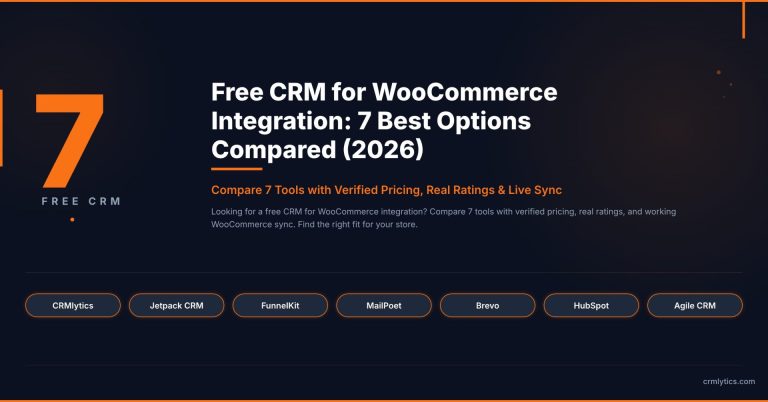
I found seven tools where the WooCommerce connection is genuinely free. Each one has verified pricing, real ratings, and a working link to its official site.
1. CRMlytics
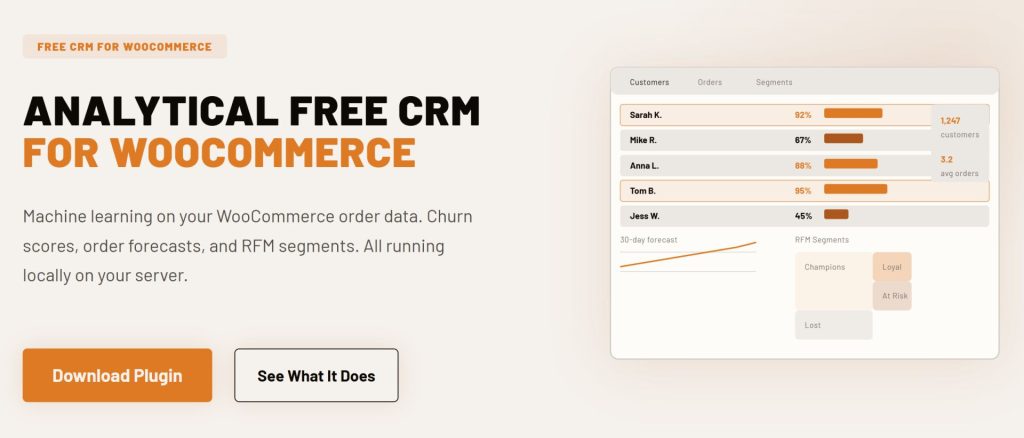
CRMlytics is a native WordPress analytical CRM that runs entirely on your server. It is 100 percent free with no paid tiers, no contact limits, and no feature gating. Unlike most CRMs that focus on sending emails or building automation workflows, CRMlytics is built around customer intelligence. It reads your WooCommerce order history and runs machine learning models directly on your server to tell you things your order data already knows but you cannot see.
The plugin calculates a health score from 0 to 100 for every customer based on their individual buying rhythm. Customers scoring below 40 are at critical risk of churning. It also predicts how many orders each customer will place in the next 30, 90, and 180 days. The predictions use the BG/NBD model, a statistical framework for repeat purchase forecasting. Fader, Hardie, and Lee published the original paper in 2005, and peer-reviewed comparisons have confirmed its accuracy since then.
RFM scores (Recency, Frequency, Monetary) calculate automatically for every customer. The plugin sorts them into segments like Champions, Loyal, At Risk, and Lost. You can build custom segments by stacking rules based on order count, average order value, health score, tags, and purchase dates. The plugin also includes built-in email campaigns with five templates, click tracking, color-coded smart tags that update automatically, customer timelines, custom fields, and one-click CSV export.
Everything runs on your own server with no API calls, no cloud sync, and no monthly fees. I have seen it tested on stores with over 200,000 orders and 15,000 customers without any storefront slowdown.
- Architecture: Native WordPress plugin
- Rating: 5 out of 5 stars on WordPress.org
- Free tier limits: 100 percent free. Unlimited contacts and orders. No paid tiers.
- Best for: Store owners who want predictive analytics and customer intelligence without paying enterprise prices. Pairs well with an operational CRM like FunnelKit or MailPoet for email outreach.
2. Jetpack CRM
Jetpack CRM is owned by Automattic, the company behind WordPress.com and WooCommerce. The core plugin is free and includes a built-in WooSync module that pulls in your store data automatically. It used to be called “Zero BS CRM” and the philosophy stuck. The interface is clean and focused on practical business tools like invoicing, quotes, and client portals.
The free WooSync module imports your WooCommerce customers and orders automatically. You also get client portals where customers can log in and view their past quotes, invoices, and transactions. The quote builder lets you create and send professional quotes from your WordPress dashboard and convert accepted quotes into invoices with one click. For businesses that handle custom work, you can manually bill clients for services or bulk orders that do not fit a standard WooCommerce checkout.
Some premium extensions like Stripe sync, PayPal sync, and Mail Campaigns cost extra. But the free WooCommerce connection and core CRM features work out of the box. Over 30,000 stores run Jetpack CRM.
- Architecture: Native WordPress plugin
- Rating: 4.3 out of 5 stars on WordPress.org (30,000+ active installations)
- Free tier limits: Unlimited contacts. Premium extensions cost extra.
- Best for: Freelancers, B2B sellers, and wholesale operators who need invoicing, quotes, and client management alongside WooCommerce.
3. FunnelKit Automations Lite
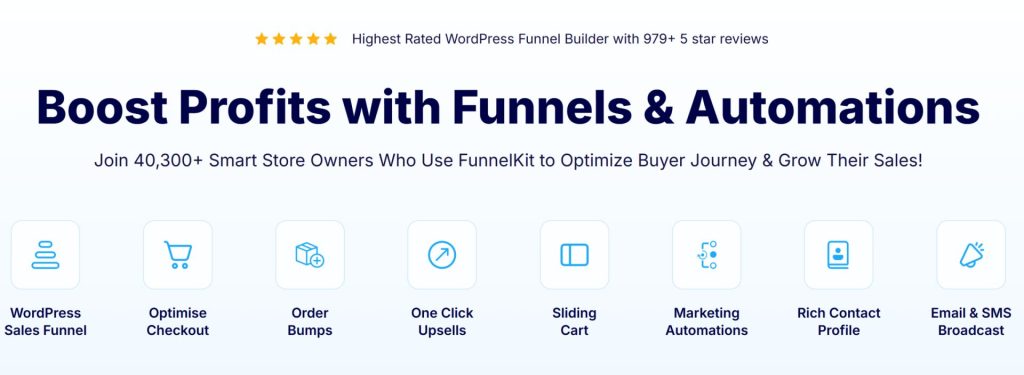
FunnelKit Automations (formerly Autonami) is a WordPress-native marketing automation plugin built for WooCommerce. The free Lite version has real WooCommerce features that most competitors lock behind a paywall, including abandoned cart recovery and a visual workflow builder. All contact data stays on your own server. The plugin does not send your customer information to any external service.
You can build automation sequences using a drag-and-drop interface with triggers based on WooCommerce events like new orders, status changes, and refunds. The Lite version includes a basic abandoned cart workflow that captures cart data when customers enter their email at checkout and sends follow-up reminders. Pre-built automation recipes for welcome emails, post-purchase follow-ups, and review collection are available with one click. It also has a rich text editor for transactional emails.
Over 40,000 stores use FunnelKit Automations. It has a 4.9 out of 5 rating on WordPress.org from hundreds of five-star reviews. The free version stores unlimited contacts. If you later need advanced segmentation, SMS marketing, or a drag-and-drop email designer, the Pro version starts at $99.50 per year.
- Architecture: Native WordPress plugin
- Rating: 4.9 out of 5 stars on WordPress.org (40,000+ active installations)
- Free tier limits: Unlimited contacts. No broadcast campaigns, SMS, or advanced segmentation in the free version.
- Best for: Stores where abandoned carts are leaving money on the table. The free cart recovery workflow alone makes this worth installing.

4. MailPoet
MailPoet is primarily an email marketing tool, but it also works as a lightweight CRM for stores that communicate mainly through newsletters. It runs entirely inside your WordPress dashboard. You write emails, check open rates, and manage subscriber lists without leaving your site. MailPoet also solves a common headache: email deliverability. Its dedicated sending service handles the technical side of getting your emails into inboxes, even on the free plan.
The free plan covers up to 1,000 subscribers with 5,000 emails per month. You can use the drag-and-drop builder to redesign the default WooCommerce transactional emails and make them look professional. Automated store emails for abandoned cart recovery, first-time purchase follow-ups, and product recommendations are all included. There are over 70 email templates to start from. More than 500,000 active installations make MailPoet one of the most common email tools in WordPress.
- Architecture: Native WordPress plugin
- Rating: 4.4 out of 5 stars on WordPress.org (500,000+ active installations)
- Free tier limits: 1,000 subscribers, 5,000 emails per month. MailPoet branding in emails.
- Best for: New stores that focus on email engagement and want a built-in sending service without leaving WordPress.
5. HubSpot for WooCommerce
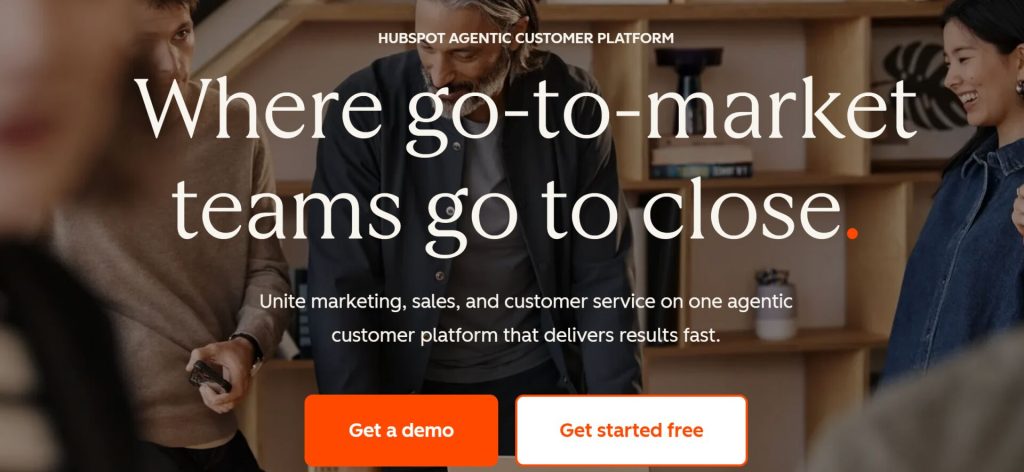
HubSpot for WooCommerce connects your store to HubSpot’s free CRM tier. You do not manage customers inside WordPress with this one. Instead, the plugin syncs your data to HubSpot’s external dashboard where you handle your marketing and sales. The integration plugin is free, and so is HubSpot’s base CRM. HubSpot has over 288,000 customers globally and a 4.4-star rating on G2 from over 10,000 reviews.
The free tier includes contact and order sync, abandoned cart tracking, one deal pipeline, live chat, meeting scheduling, and email tracking. You can connect your HubSpot account to Facebook, Instagram, LinkedIn, and Google Ads to build audiences from your purchase data. The main limitation is the 1,000-contact cap for accounts created after September 2024. Growing stores will hit that limit fairly quickly. Advanced marketing automation requires paid plans starting at $20 per month, and the Marketing Hub Professional tier jumps to $890 per month.
- Architecture: Cloud SaaS (data lives on HubSpot’s servers)
- Rating: 4.4 out of 5 stars on G2 (288,000+ customers). WordPress plugin: 3.9 out of 5 stars (7,000+ active installations)
- Free tier limits: 1,000 contacts, 2 users, 2,000 marketing emails per month. HubSpot branding on all assets.
- Best for: Stores that plan to scale into a larger marketing operation and do not mind data living on external servers.
6. Brevo
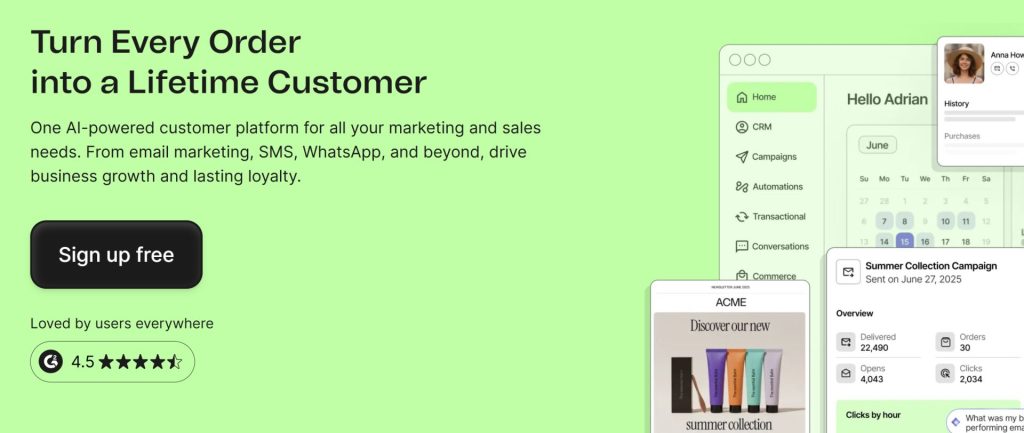
Brevo (formerly Sendinblue) is a cloud-based marketing platform with a free WooCommerce plugin that syncs your store data in real time. The big difference from most cloud CRMs: Brevo’s free plan has unlimited contact storage. You pay based on email volume, not how many customers you have. Brevo has over 500,000 active business accounts and a 4.5-star rating on G2 from over 2,300 reviews.
The WooCommerce plugin is quick to install and starts syncing your existing customers and orders right away. It also places a tracking script on your store so you can see customer behavior like product views, cart updates, and purchases. The free plan lets you send up to 300 emails per day (roughly 9,000 per month) using their drag-and-drop editor. Basic marketing automation for up to 2,000 contacts is included. Brevo’s Conversations feature gives you free live chat for one user.
- Architecture: Cloud SaaS (data lives on Brevo’s servers)
- Rating: 4.5 out of 5 stars on G2 (500,000+ business accounts)
- Free tier limits: 300 emails per day, unlimited contacts, 1 user. Brevo branding in emails.
- Best for: Store owners who want a multi-channel marketing tool with unlimited contact storage on the free plan. Good for budget-conscious stores with large lists.
7. Growffinity CRM
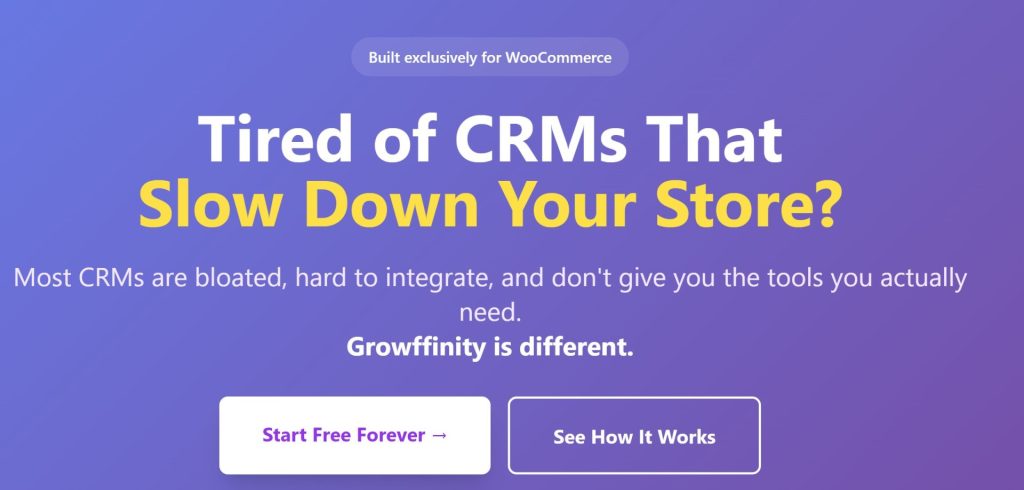
Growffinity is a cloud-connected CRM that syncs your WooCommerce customers and orders to an external dashboard. It is a freemium tool based on customer count. The setup is fast, and the interface is simpler to navigate than platforms like HubSpot or Salesforce. If larger CRM platforms overwhelm you with their endless menus and complicated terminology, Growffinity is a cleaner alternative.
Install the plugin, connect your free account, and your historical WooCommerce orders sync over automatically. When a customer makes a purchase, their profile in the Growffinity dashboard updates instantly. You can build basic customer segments based on order history and behavior, even on the free tier. Simple reports on customer activity and store performance are included.
- Architecture: Cloud SaaS (data lives on Growffinity’s servers)
- Free tier limits: 350 customers, 1 WooCommerce store, basic analytics. Paid plans start at $29 per month for 1,000 customers.
- Best for: Brand-new stores that want a simple, clean dashboard for managing their first few hundred sales with a five-minute setup.
Comparison Table: 7 CRMs at a Glance
This table compares all seven best free CRM for WooCommerce tools side by side. Use it to narrow down your options before reading the detailed breakdowns above.
| CRM | Architecture | Free Contact Limit | Predictive Analytics | Key Free Feature |
|---|---|---|---|---|
| CRMlytics | Native WP | Unlimited | Yes (BG/NBD, RFM) | Churn scores, order forecasts, RFM segmentation |
| Jetpack CRM | Native WP | Unlimited | No | Client portals, invoicing, quotes |
| FunnelKit Automations Lite | Native WP | Unlimited | No | Abandoned cart recovery, visual workflow builder |
| MailPoet | Native WP | 1,000 | No | Email customizer, built-in sending service |
| HubSpot for WooCommerce | Cloud | 1,000 | No | Deal pipelines, ad targeting, live chat |
| Brevo | Cloud | Unlimited | No | 300 emails/day, live chat, automation |
| Growffinity CRM | Cloud | 350 | No | One-click sync, simple dashboard |
How RFM Segmentation Improves Revenue
If you have never heard of RFM segmentation, the short version is this. RFM stands for Recency, Frequency, and Monetary value. It sorts customers into groups based on how recently they bought, how often they buy, and how much they spend. Different groups need different marketing messages. A customer who bought last week does not need a win-back discount. A customer who has not bought in six months might.
The results from real stores back this up. Lapin House, a Greek children’s clothing brand, implemented RFM segmentation through their Customer Data Platform and saw their revenue jump by 23 percent while cutting their paid ads budget by 40 percent. Customer lifetime value climbed from 58 euros to 105 euros, and their retention rate doubled from 10 percent to 20 percent. They used four years of purchase data to map customers into RFM groups and built campaigns targeting each segment differently. You can read the full case study at sem-wizard.com.
The Man Company, an Indian men’s grooming brand, had a list of 385,500 subscribers but no segmentation. Their email campaigns had poor conversion rates. After implementing RFM analysis to segment their master list by buying behavior, they sent 10 million emails in one quarter, 102 percent more than before. That generated 172 percent higher revenue than their previous performance. Their unsubscribe rate also dropped by 48 percent. The full case study is available at retainup.co.
Ruffwear, a premium dog gear brand, used Klaviyo’s RFM segmentation to identify disengaged customers who were all receiving the same generic re-engagement flows. By sorting customers into “Needs attention” and “At risk” segments based on their purchase history, they triggered personalized retention flows with product recommendations. In six months, their discount rate dropped 10 percent year over year while overall revenue grew 9 percent. The case study is on klaviyo.com.
These results are not unusual. RFM works because it treats customers differently based on their actual behavior instead of blasting everyone with the same message. Among the best free CRM for WooCommerce options on this list, CRMlytics calculates RFM scores automatically for free. The other tools require you to build segments manually using purchase data, which works but takes more effort.
How to Choose the Right Free CRM for Your Store
The right tool depends on what you need most right now. I would break it down like this.
- You want to understand your customers better. Pick CRMlytics. The predictive analytics, health scores, and RFM segmentation give you insights that usually cost hundreds of dollars per month on other platforms.
- You need to send invoices and manage B2B relationships. Pick Jetpack CRM. The client portals and quote builder are built for service-based and wholesale businesses.
- You want to recover abandoned carts without paying. Pick FunnelKit Automations Lite. The free version has a working abandoned cart workflow, which most competitors charge for.
- Email newsletters are your main marketing channel. Pick MailPoet. The WooCommerce email customizer and built-in sending service make it the best free option for email-focused stores.
- You plan to grow into a large marketing operation. Pick HubSpot for WooCommerce. The free tier has limits, but it connects you to one of the biggest marketing ecosystems available.
- You want unlimited contacts on a cloud platform. Pick Brevo. No other free cloud CRM on this list gives you unlimited contact storage.
- You want the simplest possible setup. Pick Growffinity. Install the plugin, connect your account, and you are done in under five minutes.
Why Two Tools Beat One
After going through all seven options, I think the mistake most store owners make is trying to solve every problem with a single CRM. Many successful stores use two tools together. They use an analytical CRM like CRMlytics to figure out who needs attention (churning customers, high-value segments, forecasted buyers). Then they use an operational CRM like FunnelKit Automations Lite or MailPoet to send the actual emails. This dual-engine approach works better than picking one tool and hoping it does everything.
This two-tool approach is not unusual. Klaviyo pairs with Metorik for analytics. ActiveCampaign pairs with Google Analytics for reporting. HubSpot has its own reporting add-ons. The pattern repeats everywhere: separate the intelligence layer from the execution layer. On WordPress, you can do the same thing for free. CRMlytics handles the “who to target” part. FunnelKit or MailPoet handles the “how to reach them” part. Together, they give you better targeting than a single expensive SaaS subscription because the predictions drive the automation.
Wrapping Up
You do not need a big budget to start managing your customers properly. Every tool on this list has a working free connection to WooCommerce that pulls in your store data without costing anything. Whether you want deep predictive analytics, abandoned cart recovery, or a simple contact dashboard, the best free CRM for WooCommerce stores is the one that fits your specific needs right now.
If I had to pick one starting point, I would install CRMlytics for the customer intelligence and pair it with FunnelKit Automations Lite or MailPoet for email outreach. Both are free. Connect one to your store this week and see what your order data has been telling you.