Best CRM for WooCommerce Small Business 2026: An Honest Comparison of 12 Tools
Every WooCommerce store collects a lot of data. Names. Email addresses. Every product someone clicked. Every cart they abandoned. Every order they placed. Most store owners look at that data and see nothing useful. It is just numbers sitting in a database with no story attached.
Small businesses face a real problem when shopping for the best CRM for WooCommerce small business 2026. Most CRMs are either built for enterprise budgets or charge per-contact fees that crush you as you grow. Klaviyo hits $1,200 a month at 100,000 contacts. HubSpot jumps from free straight to $1,600 a month at the Professional tier. And most of the free WordPress plugins only do one thing well while ignoring everything else.
On top of that, most “best CRM for WooCommerce ” lists you find online are written by affiliates pushing whichever tool pays the highest commission. The recommendations have nothing to do with what actually works for a small store.
This guide is different. I compared 12 CRMs across three categories: WordPress-native plugins, cloud-based platforms, and analytics-first tools. I include real pricing at every scale, honest weaknesses for each tool, and clear scenarios for when each one makes sense. I also tell you exactly where our own product falls short compared to the competition.
What Small Businesses Actually Need from a CRM
After researching over a dozen options and running a WooCommerce store myself, I landed on six criteria that separate a useful CRM from an expensive mistake.
1. Pricing Model
Per-contact pricing is the single biggest trap for small businesses. A store with 30,000 contacts paying $0.01 per contact per month spends $3,600 a year before they send a single email. Flat-rate WordPress plugins eliminate this entirely. You pay the same price whether you have 100 contacts or 100,000. The best CRM for WooCommerce small business 2026 should either use flat pricing or give you a very generous free tier.
2. Data Ownership
Self-hosted CRMs keep your customer data on your own server. Cloud CRMs sync everything to an external platform. The choice affects your GDPR compliance, what happens if you cancel your subscription, and whether your data is safe if the vendor changes their policies.
3. WooCommerce Integration Depth
Some CRMs sync orders natively. Others need a Zapier bridge or a third-party plugin that may break after the next update. Native integration is always better for reliability and data accuracy.
4. Automation Capability
Abandoned cart recovery alone can bring back 5 to 15 percent of lost revenue. That single automation often pays for the CRM by itself. Post-purchase follow-ups, review requests, and win-back sequences are equally important.
5. Analytics and Predictions
Most CRMs tell you what already happened. A few tell you what will happen next. RFM scoring, health scores, churn probability, and future order predictions let you act before customers leave. This is where the best CRM for WooCommerce small business 2026 separates from the pack.
6. Ease of Setup
Can a non-technical store owner install and configure this in an afternoon? Or does it need a developer, a dedicated server config, and a week of setup time? Small businesses do not have the luxury of long implementation cycles.
Category A: WordPress-Native (Self-Hosted) CRMs
These plugins install directly into your WordPress dashboard. All data stays on your server. No monthly subscription fees based on contact count. If data ownership and predictable costs matter to you, one of these is likely the best CRM for WooCommerce small business 2026.
1. FunnelKit Automations: Best for WooCommerce Revenue Automation
Price: Free lite version available. Premium starts at $99.50 per year with unlimited contacts and unlimited emails.
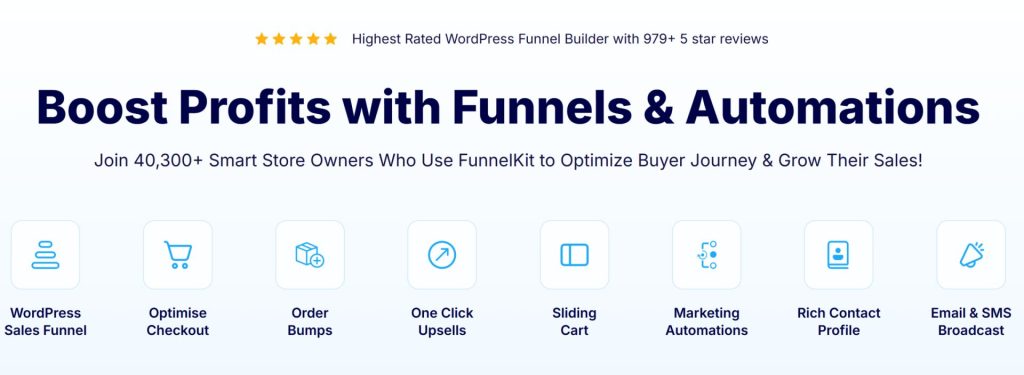
FunnelKit Automations was built specifically for WooCommerce, and it shows. The integration depth is unmatched among WordPress-native CRMs. Abandoned cart recovery, post-purchase sequences, cross-sell campaigns, upsell offers, review requests, and dynamic coupon generation all work out of the box without needing third-party plugins.
The visual automation builder supports branching logic based on order value, product category, and customer behavior. You can create sophisticated flows like “if the customer bought shoes, offer socks after 3 days; if they bought a laptop, offer a case after 5 days” entirely through the interface.
It connects with over 100 plugins and WooCommerce extensions including Memberships and Subscriptions. A/B testing is built in for subject lines, content, discounts, and send timing.
Where it falls short: FunnelKit is weak outside of WooCommerce. It does not integrate with LMS plugins, membership platforms, or form builders the way FluentCRM does. It has zero predictive analytics. The email builder is functional but nowhere near as polished as Klaviyo or ActiveCampaign.
Best for: WooCommerce stores where abandoned cart recovery, post-purchase automation, and revenue optimization are the primary goals.
2. FluentCRM: Best for Email Marketing Automation at Scale
Price: Free tier available (limited). Pro starts at $129 per year per site. 5-site license at $249 per year. Unlimited license at $499 per year.
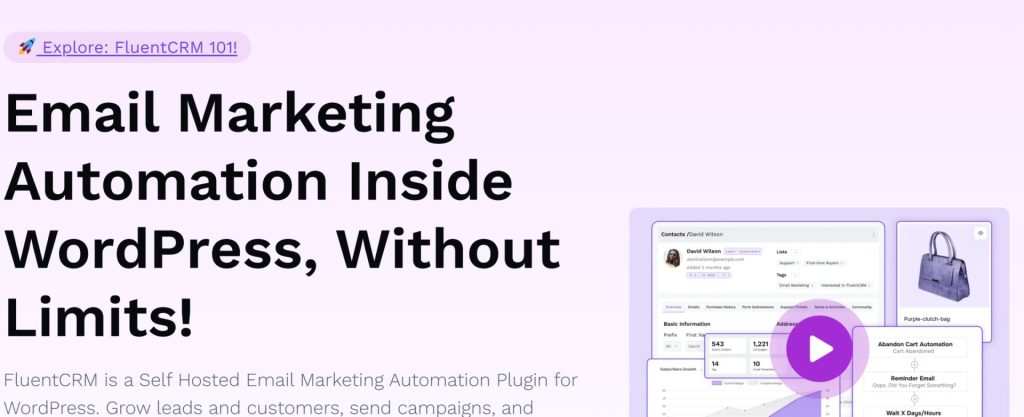
FluentCRM is the most popular WordPress-native CRM with over 70,000 active installations and a 96 percent five-star rating. It is self-hosted, stores everything in your own database, and charges a flat annual fee regardless of how many contacts you have.
The automation builder is comprehensive with triggers for WooCommerce purchases, form submissions, membership changes, LMS course completions, and custom events. Contact profiles aggregate purchase history, email engagement, course progress, and support interactions into a single 360-degree view.
FluentCRM 3.0 added SMS marketing with two-way messaging support. The platform integrates with 45+ WordPress plugins natively. A/B testing for email subject lines and send times is built into every plan.
Where it falls short: You need to configure SMTP separately (Amazon SES, SendGrid, or similar). The email editor is functional but does not match the design polish of Klaviyo. There is no autosave in the email composer, which means you can lose work if you navigate away mid-draft. No predictive analytics for churn or customer health.
Best for: Email-driven businesses that want strong automation at flat annual pricing without per-contact fees.
3. Jetpack CRM: Best Free CRM for Simple Contact Management
Price: Free core plugin. Freelancer plan at $11 per month. Entrepreneur plan at $17 per month (billed annually) which includes all 30+ extensions.
Jetpack CRM is built by Automattic, the company behind WordPress.com. The free core handles contact management, invoicing, quotes, and transaction tracking. It integrates with WooCommerce through the WooSync module, which automatically creates customer records from orders.
The interface is clean and approachable for non-technical users. It includes a client portal where customers can view their invoices and manage their information. B2B mode allows tracking company-contact relationships for wholesale accounts.
Where it falls short: The free version is genuinely limited. Segmentation is tag-based only, with no WooCommerce-specific filters like purchase history. Automation covers quotes and invoices but not cart abandonment or order follow-ups. Email broadcasting costs an extra $79 per year. The sales dashboard costs an extra $129 per year. Most useful features require paid extensions, which makes the “free” label misleading for anything beyond basic contact storage.
Best for: Freelancers and very small stores that need simple contact management plus invoicing without monthly commitments.
4. Groundhogg: Best Open-Source CRM for Developers and Agencies
Price: Free core. Basic $20 per month. Plus $40 per month. Pro $50 per month. Agency $100 per month. Unlimited contacts on every paid plan.
Groundhogg is the only fully GPL-licensed CRM plugin for WordPress. You own the code completely. You can modify it, redistribute it, or white-label it for client deployments without restriction. This makes it the most flexible option for agencies and developers.
Version 4.0 (March 2025) introduced a redesigned flow editor with drag-and-drop triggers, conditional branching, and lead scoring that categorizes contacts as hot, warm, or cold automatically. Native WooCommerce integration on the Pro plan provides order-based triggers, dynamic coupon generation, and customer segmentation by purchase history and lifetime value.
SMS and WhatsApp messaging are available through Twilio integration. The REST API and hundreds of developer hooks allow extensive customization. The Agency plan includes white-label branding and a partner certification program that pays 30 percent recurring commissions on client referrals.
Where it falls short: Setup requires technical knowledge. You must configure SMTP services, set up server-level cron jobs, and manage caching exclusions. The documentation assumes existing CRM knowledge. The linear flow approach in the builder does not match the flowchart style some marketers prefer. WooCommerce integration is a paid add-on.
Best for: WordPress developers, agencies managing multiple client sites, and businesses with strict compliance requirements that demand full code access.
5. CRMlytics: Best Predictive Analytics CRM (Our Product)
Price: Completely free. No paid tiers, no upsells, no contact limits, no data sent outside your server.
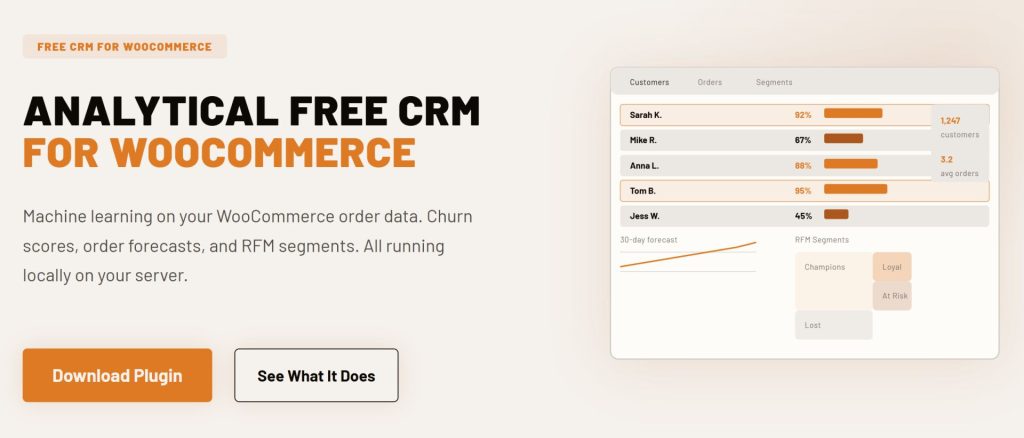
CRMlytics runs a BG/NBD (Beta Geometric/Negative Binomial Distribution) statistical model on your WooCommerce order history to tell you which customers are about to churn, which ones are worth your marketing budget, and how many orders each customer will place in the next 30, 90, and 180 days.
Every customer gets a health score from 0 to 100. Repeat buyers are scored by the model’s alive probability. One-time customers start at 80 and decay over time if they do not return. RFM scores (Recency, Frequency, Monetary) are calculated automatically using percentile-based SQL across your entire customer base.
Smart tags update automatically as customer behavior changes. A full customer timeline shows orders, email opens, link clicks, manual notes, and phone calls in one unified view. You can send emails directly from the plugin using WordPress’s built-in mail system or any SMTP plugin you already have.
Where it falls short: CRMlytics has no marketing automation builder, no abandoned cart recovery, and no workflow system. It is not a replacement for FunnelKit or FluentCRM. It requires WooCommerce specifically.
Best for: Store owners who want real predictive analytics, churn detection, and RFM scoring at zero cost. It works best when paired with an operational CRM like FunnelKit or FluentCRM for automation.
Category B: Cloud-Based CRMs
These platforms sync your WooCommerce data to external servers. They usually offer more polish, deeper analytics, and multi-channel support than self-hosted options. The trade-off is recurring monthly costs that scale with your contact list. Several of these are strong candidates for the best CRM for WooCommerce small business 2026 depending on your growth stage.
6. Klaviyo: Best Cloud Platform for Email + Predictive Analytics
Price: Free up to 250 contacts. $20 per month up to 500 contacts. Scales to $1,200+ per month at 100,000 contacts. Marketing Analytics add-on starts at $100 per month.
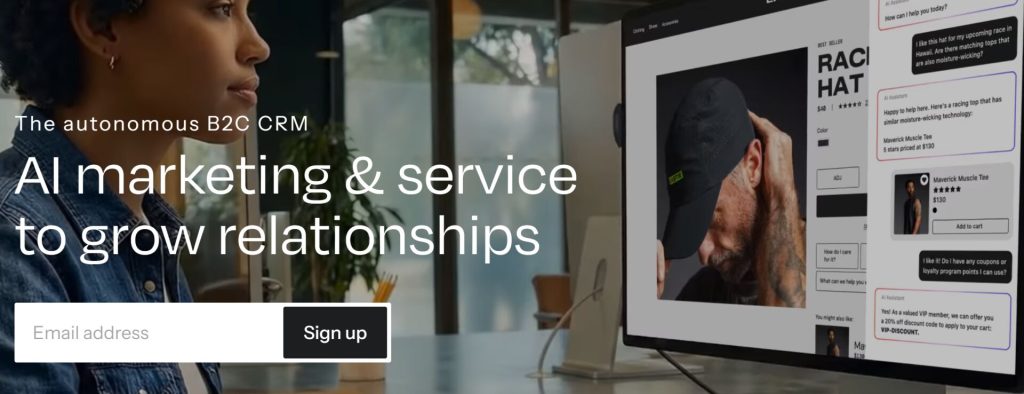
Klaviyo combines a Customer Data Platform (CDP) with email, SMS, mobile push, and product review marketing. It syncs WooCommerce data in real time and builds unified customer profiles automatically. The predictive analytics engine calculates customer lifetime value, churn risk probability, and predicted next order date for every contact.
The platform includes 60+ pre-built automation flows for abandoned cart, browse abandonment, post-purchase sequences, win-back campaigns, and more. RFM analysis, funnel analysis, product analysis, and cohort analysis are all available through the Marketing Analytics add-on.
Segmentation is the strongest feature in this category. You can build segments based on purchase behavior, email engagement, predictive analytics values, web activity, and custom properties combined with AND/OR logic. The AI-powered segment and flow builder can create complex targeting rules from natural language descriptions.
Where it falls short: Contact-based pricing becomes expensive fast. At 100,000 contacts you pay over $1,200 per month. Your data lives on Klaviyo’s servers. The Marketing Analytics add-on with RFM and cohort tools costs extra. For a small store with a tight budget, the costs can outgrow the benefits.
Best for: DTC brands that treat email and SMS as primary revenue channels and need enterprise-grade predictive analytics.
7. ActiveCampaign: Best Automation Builder for Complex Workflows
Price: Starter $49 per month (1,000 contacts, 1 user). Plus $79 per month. Professional $129 per month.
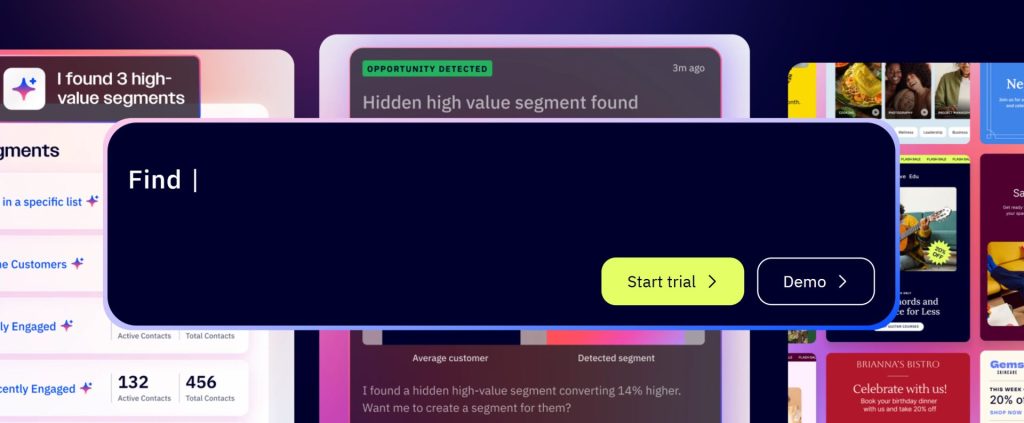
ActiveCampaign is known for the depth of its automation builder. Conditional branching, lead scoring, attribution modeling, and goal-based funnels all work natively. The platform supports multi-channel campaigns across email, SMS, and WhatsApp from a single workflow.
The WooCommerce integration plugin syncs orders, products, customers, and abandoned cart data in real time. Historical sync lets you import past order data when you first connect. Browse abandonment tracking captures shoppers who leave without purchasing. Predictive sending optimizes delivery time for each individual contact based on their engagement history.
The product catalog syncs automatically so you can reference current products in your emails. The machine learning models behind predictive content and sending are solid for a cloud CRM at this price point.
Where it falls short: The email builder does not support native WooCommerce product blocks, so promoting specific products requires manual work. The Starter plan limits automations to five actions per workflow, which is restrictive for complex funnels. Data lives on ActiveCampaign’s servers. Pricing scales with contact count.
Best for: Stores that need complex multi-branch automation funnels with conditional logic and attribution tracking.
8. HubSpot: Best Free Tier for All-In-One CRM
Price: Free tier (unlimited users and contacts). Starter around $20 per user per month. Professional $1,600 per month flat.
HubSpot’s free tier is genuinely generous for a cloud CRM. You get contact management, deal pipelines, email tracking, meeting scheduling, and basic reporting at no cost with unlimited users. The WooCommerce integration plugin syncs orders, products, customers, and cart abandonment events into HubSpot contacts and deals.
Seven built-in ecommerce reports cover customer acquisition, revenue performance, and product trends. The platform connects with over 1,500 third-party apps. Email marketing, social media publishing (Facebook, Instagram, LinkedIn, Google ads), and form builders are included in the free tier.
Where it falls short: The Professional tier pricing cliff ($1,600 per month flat) is a shock for small businesses that have built their workflows inside HubSpot’s free tier. The WooCommerce integration is basic compared to native WordPress plugins. No native SMS or WhatsApp without paid add-ons. You cannot insert WooCommerce products directly into emails. The free version shows HubSpot branding on marketing emails.
Best for: Small teams that want a free all-in-one CRM with sales pipeline, marketing, and basic WooCommerce integration.
9. Drip: Best for Ecommerce Email Automation on a Budget
Price: $39 per month for up to 2,500 people. $99 per month for 5,001 to 10,000 people. Scales from there.
Drip is an ecommerce-focused marketing automation platform that fills the gap between budget tools and expensive enterprise platforms like Klaviyo. The visual workflow builder includes pre-built playbooks for welcome series, abandoned cart recovery, and win-back campaigns. Behavioral segmentation lets you filter by purchase history, purchase frequency, products viewed, and email engagement.
The WooCommerce integration syncs customer data, orders, and products. Onsite campaigns (popups and forms) help collect emails and zero-party data directly from your store. Revenue reporting ties campaign performance to actual sales. Free migration from your previous platform is included, along with personalized onboarding.
Where it falls short: The email builder does not support native WooCommerce product blocks, which limits dynamic content for product promotions. Predictive analytics are less advanced than Klaviyo. Data lives on Drip’s servers. Pricing scales with your contact list. It is a cloud platform, so your data is not self-hosted.
Best for: Mid-size ecommerce stores that want solid email automation without immediately jumping to Klaviyo pricing.

10. Zoho CRM: Best for Businesses Already in the Zoho Ecosystem
Price: Free for 3 users. Standard $14 per user per month. Professional $23 per user per month.
Zoho CRM is a comprehensive cloud CRM with sales pipeline management, AI assistant (Zia), custom modules, and workflow automation. RFM segmentation is built in natively. The real strength is the Zoho ecosystem: a single WooCommerce order can flow into Zoho CRM as a deal, Zoho Books as an invoice, Zoho Inventory as a stock decrement, and Zoho Desk as a customer record simultaneously.
The Deluge scripting language allows custom data transformations during WooCommerce sync. This makes Zoho uniquely flexible for complex data workflows that other CRMs cannot handle without custom development.
Where it falls short: WooCommerce integration requires a third-party bridge plugin (WP Swings at $129 per year, CRM Perks, or similar) which adds ongoing maintenance and potential breakage after WordPress updates. Zoho is not designed specifically for ecommerce. The free tier has strict API limits (5,000 calls per day). Setup is complex compared to WordPress-native options. For a pure WooCommerce store with no existing Zoho investment, there are easier and cheaper options.
Best for: Stores already using Zoho products (Books, Inventory, Campaigns) or businesses that need a hybrid B2B and ecommerce CRM.
Category C: Analytics-First Tools
These tools focus on making sense of your WooCommerce data rather than automating workflows. If you already have an email platform but need deeper insights into customer behavior, these are worth your attention. Both deserve consideration for the best CRM for WooCommerce small business 2026 if analytics is your primary need.
11. Metorik: Best for Deep WooCommerce Analytics and Reporting
Price: Starter $25 per month (up to 100 orders). Medium $50 per month (up to 500 orders). Large $100 per month (up to 2,500 orders). All features included on every plan. Unlimited users.
Metorik provides over 75 real-time reports covering sales, profit, customers, products, subscriptions, taxes, and shipping. Profit tracking includes COGS (cost of goods sold), shipping costs, and ad spend integration so you see true profitability per product and per customer. Customer cohort analysis and lifetime value tracking help spot retention trends before they become problems.
The advanced segmentation system lets you build targeted customer lists based on any combination of purchase history, behavior, and custom fields. The Engage email platform is built in for sending campaigns and automations directly from Metorik. Every plan includes email sends alongside the analytics features.
Q1 2026 added an API for external data access, Custom Metrics for building your own KPIs, Operational Costs tracking for full profitability, and an AI-powered segment builder called Jarvis. The platform holds a 4.9 out of 5 rating across 159 reviews.
Where it falls short: Metorik is not a full CRM. It does not have contact profiles with interaction timelines, call logging, or manual note tracking. Pricing is based on order volume, which means costs rise automatically as your store grows. It is cloud-based, so data syncs to Metorik’s servers.
Best for: Data-driven store owners who want deep WooCommerce analytics, profit tracking, and cohort analysis in a single dashboard.
12. Metrilo: Best All-In-One Analytics + CRM + Email Platform
Price: Small $119 per month (up to 10,000 visitors). Medium $299 per month. Large $499 per month. Enterprise $699 per month. Annual billing discounts available.
Metrilo combines ecommerce analytics, CRM, and email marketing into a single platform. The analytics cover product performance (which products drive first purchases versus repeat purchases), conversion funnels, marketing channel performance, and real-time dashboards. The CRM component provides customer profiles with purchase history and behavior tracking.
The retention analysis tools are the most useful part of Metrilo. Cohort comparisons and customer lifetime metrics show how different acquisition groups behave over time and where retention drops off. The email marketing module includes a drag-and-drop builder, automation rules, abandoned cart recovery, and customer feedback surveys sent automatically after purchase.
Metrilo combines all three functions in one platform. If you are currently paying for Metorik (analytics) plus Klaviyo (email) plus a separate CRM, Metrilo at $119 per month may actually reduce your total tool costs.
Where it falls short: The starting price of $119 per month is steep for small stores. The CRM features overlap with tools you may already have. For stores under $50,000 in monthly revenue, it is often overkill. The analytics are less WooCommerce-specific than Metorik’s. Data lives on Metrilo’s servers.
Best for: Growing stores that want to consolidate analytics, CRM, and email into a single platform rather than paying for three separate tools.
Comparison Table: Best CRM for WooCommerce Small Business 2026
Here is how all 12 tools compare across the criteria that matter most for small businesses. I estimated costs at roughly 5,000 contacts to give an apples-to-apples pricing comparison. This table makes it easy to see which best CRM for WooCommerce small business 2026 candidate fits your budget and feature priorities.
| CRM | Price (5k Contacts) | Self-Hosted | Email Automation | Predictive ML | Abandoned Cart | WooCommerce Depth |
|---|---|---|---|---|---|---|
| CRMlytics | $0 | Yes | No (insights only) | Yes (BG/NBD) | No | Deep (read) |
| FunnelKit | $99/yr | Yes | Yes | No | Yes | Deepest |
| FluentCRM | $129/yr | Yes | Yes | No | Yes | Deep |
| Jetpack CRM | $132-204/yr | Yes | Add-on $79/yr | No | No | Basic |
| Groundhogg | $240-600/yr | Yes | Yes | No | Yes | Good |
| Klaviyo | ~$240/yr+ | No | Yes | Yes (CLV/Churn) | Yes | Native |
| ActiveCampaign | ~$588/yr | No | Yes | No | Yes | Plugin |
| HubSpot | ~$240/yr+ | No | Limited (free) | No | Yes | Basic |
| Drip | $468/yr | No | Yes | No | Yes | Native |
| Zoho CRM | $504/yr (3 users) | No | Yes | No | Via bridge | Third-party |
| Metorik | $300-600/yr | No | Yes | No | No | Deep (analytics) |
| Metrilo | $1,428/yr | No | Yes | No | Yes | Good |
A few things jump out from this table. First, the WordPress-native options are dramatically cheaper than cloud alternatives at scale. Second, only two tools on this list offer any form of predictive machine learning: Klaviyo and CRMlytics. Third, there is a clear trade-off between automation depth and analytical depth. No single tool excels at both.
When to Choose What
There is no universal best CRM for WooCommerce small business 2026. The right choice depends entirely on your priorities. Here are specific scenarios to help you decide.
I need abandoned cart recovery and upsells. Pick FunnelKit Automations. Nothing else on this list is as WooCommerce-native for revenue automation. The $99.50 annual price is a steal for unlimited contacts and emails.
Email marketing is my primary channel. Pick FluentCRM. The flat $129 per year for unlimited contacts beats everything at scale. The 45+ integrations make it flexible for stores that also run memberships or courses.
I want to know who is about to churn. Pick CRMlytics. It is the only option with BG/NBD predictive modeling at zero cost. Pair it with FunnelKit or FluentCRM for the automation side.
I need a simple CRM with invoicing. Pick Jetpack CRM. The free core handles contacts and invoices well for freelancers and very small stores.
I run an agency and need white-label CRM. Pick Groundhogg. The GPL license and Agency plan are unmatched for client deployments. The 30 percent recurring commission on referrals adds up.
I want enterprise predictive analytics in the cloud. Pick Klaviyo. The CLV predictions and churn risk are best-in-class. Budget for the cost at your contact volume before committing.
I want a free all-in-one cloud CRM to start. Pick HubSpot. The free tier is generous with unlimited users and contacts. Just be aware of the pricing cliff at the Professional tier.
I need complex multi-branch automation. Pick ActiveCampaign. Its conditional logic, scoring, and goal-based funnels are the deepest in this comparison.
I want WooCommerce analytics without a full CRM. Pick Metorik. The 75+ reports, profit tracking, and cohort analysis are unmatched for pure analytics.
I want to consolidate three tools into one. Pick Metrilo if you are paying for separate analytics, CRM, and email tools and the combined cost exceeds $119 per month.
How CRMlytics Fits In: An Honest Assessment
Since I work on CRMlytics, I want to be especially clear about where it fits and where it does not. CRMlytics is an analytical CRM. It is not an operational CRM. The difference matters.
Operational CRMs like FunnelKit and FluentCRM automate what you send: abandoned cart emails, post-purchase sequences, win-back campaigns. Analytical CRMs like CRMlytics tell you who to send those messages to and when. You need both to run a smart retention strategy.
Here is a concrete example. FluentCRM can send a win-back email to anyone who has not purchased in 60 days. That is a static rule. CRMlytics identifies customers with a health score below 40, meaning the BG/NBD model predicts they are likely to churn soon. Combine the two tools and you send win-back emails only to the customers who actually need them, not to everyone who happens to be past a calendar threshold. Your conversion rates go up and your email list stays healthier.
The honest gaps: CRMlytics was released in May 2026 and has fewer than 10 active installations. It has no automation builder. No abandoned cart recovery. No workflow system. No native integration with tools outside WooCommerce. Email delivery depends on your server’s mail configuration. The community is tiny. These are real drawbacks.
Where CRMlytics wins decisively: Price (free forever). Data privacy (everything runs locally on your server, no data ever leaves). Predictive analytics (the BG/NBD model is the same statistical framework used by enterprise platforms like Klaviyo). No contact limits. No feature gating. No upsells.
If you only need automation, pick FunnelKit or FluentCRM. If you only need predictions, pick CRMlytics. If you need both, use them together. That two-tool stack costs less than $130 per year and gives you both enterprise-grade predictions and solid automation.
Conclusion: There Is No Single Best CRM
The honest answer is that there is no single best CRM for WooCommerce small business 2026. The right choice depends on whether you need automation, analytics, or both.
For pure predictive analytics at zero cost with full data ownership, CRMlytics is the only option on this list. For revenue-driving automation, FunnelKit Automations and FluentCRM are the strongest WordPress-native choices at prices that do not scale with your success. For an all-in-one cloud platform with a generous free tier, HubSpot gets you started for nothing.
The smartest strategy for most small WooCommerce stores is a combination approach. Use CRMlytics to identify who is at risk and who is worth pursuing. Feed those insights into FunnelKit or FluentCRM for the actual campaign execution. You get the best of both worlds: enterprise predictions without enterprise costs, and solid automation without per-contact pricing.
Try CRMlytics for free on WordPress.org. Pair it with your existing automation tools and start targeting the right customers before they churn.
Frequently Asked Questions
For a completely free CRM with no limitations, CRMlytics and Jetpack CRM are your options. CRMlytics gives you predictive analytics, RFM scoring, and health scores. Jetpack CRM gives you basic contact management and invoicing. Both are free with no paid tiers required for core functionality.
That depends on your priorities. For analytics and predictions, CRMlytics is the strongest free option. For automation, FunnelKit Automations at $99.50 per year is the best value. For an all-in-one cloud platform, HubSpot’s free tier is the most generous starting point.
Yes. CRMlytics is designed to complement tools like FunnelKit and FluentCRM. It focuses on prediction and segmentation. Feed its health scores and smart tags into your operational CRM for sharper targeting. The two approaches work better together than either does alone.
Operational CRMs automate day-to-day tasks like sending emails, managing sales pipelines, and recovering abandoned carts. Analytical CRMs analyze your data to generate insights and predictions. CRMlytics is an analytical CRM. FunnelKit and FluentCRM are operational CRMs. Most businesses need elements of both. Understanding this difference is key to picking the best CRM for WooCommerce small business 2026.
For stores under $50000 in annual revenue, you should aim to spend under $200 per year on CRM tools. The combination of CRMlytics (free) plus FunnelKit Automations ($99.50 per year) or FluentCRM ($129 per year) gives you enterprise-grade predictions and solid automation well within that budget.