Best Marketing CRM for WooCommerce: Features & Integration Guide (2026)
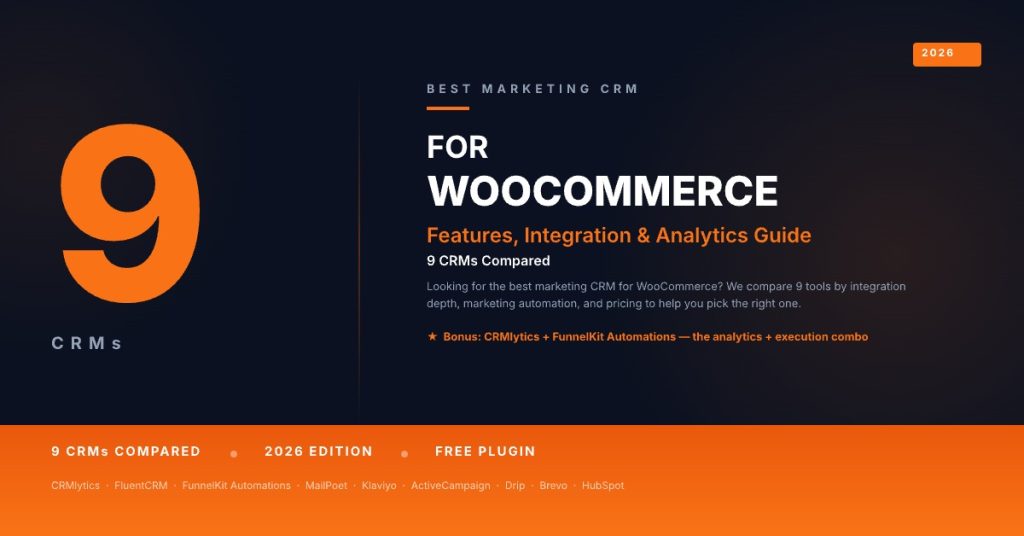
Finding a marketing CRM that actually works with WooCommerce is harder than it should be. Plenty of CRMs claim they integrate with WooCommerce, but the reality is often a shallow plugin that syncs basic contact info and nothing else.
Marketers need more than a contact list. You need integration depth. You need your CRM to understand purchase history, product data, and customer behavior. You need to segment people by what they bought and when. And you need analytics to track whether your campaigns actually moved the needle. All of these are part of picking the best marketing CRM for WooCommerce features integration approach.
I looked at nine CRMs that connect with WooCommerce in meaningful ways. Some are native WordPress plugins that run on your server. Others are cloud platforms with official integration plugins. Every tool can pull order data, segment customers by purchase behavior, and run marketing campaigns. This guide covers the best marketing CRM for WooCommerce features integration approach for each one so you can pick the right fit.
What Makes a Marketing CRM Good for WooCommerce?
Before we get into the tools, here is what I looked for when evaluating each one:
- Integration depth. Does it just sync names and emails, or does it pull order history, product categories, and lifetime value?
- Marketing features. Can you create segments, build campaigns, automate email sequences, and track results?
- Analytics. This is the big one for marketers. Can you see which campaigns drive revenue? Do you get churn insights, RFM segments, or predictive data?
- Data ownership. Does your customer data live on your server or get synced to the cloud?
- Pricing model. Does the price scale with your success, or does it stay predictable?
The table below shows how the nine tools stack up on the most important criteria for a marketing CRM.
| CRM | Best For | Starting Price | Marketing Features | Analytics Depth | Rating |
|---|---|---|---|---|---|
| CRMlytics | Predictive analytics + email campaigns | Free | Email campaigns by segment/tag, click tracking | Predictive Churn risk, RFM, order forecasts, health scores | New |
| FluentCRM | Email automation inside WordPress | $103/yr | Visual automation builder, A/B testing, 45+ integrations | Revenue attribution, email analytics | 4.8/5 (80K+ installs) |
| FunnelKit Automations | Abandoned cart + post-purchase upsells | $99.50/yr | Visual automation, abandoned cart, SMS, email campaigns | Campaign revenue reporting, A/B testing | 4.9/5 (979+ reviews) |
| MailPoet | Native WordPress email marketing | Free (500 subs) | Newsletters, automated store emails, WooCommerce email customizer | Basic email stats, WooCommerce purchase stats | 4.4/5 (500K+ installs) |
| Klaviyo | Premium email + SMS marketing flows | $20/mo (500 contacts) | Best-in-class segmentation, pre-built flows, A/B testing, SMS | Predictive CLV, churn probability, revenue attribution | 4.5/5 (65K+ brands) |
| ActiveCampaign | Advanced automation + sales CRM | $15/mo (1K contacts) | Visual automation, conditional logic, predictive sending, SMS | Attribution, conversion tracking, contact scoring | 4.5/5 (180K+ customers) |
| Drip | Ecommerce-focused marketing flows | $39/mo (2.5K contacts) | Visual workflow builder, onsite campaigns, dynamic segments | Revenue dashboards, RFM analysis, attribution | 4.4/5 |
| Brevo | Budget-friendly multi-channel marketing | Free (300 emails/day) | Email, SMS, WhatsApp, chat, marketing automation | Contact scoring (Pro), AI segmentation (Pro), basic reporting | 4.4/5 (500K+ customers) |
| HubSpot | Enterprise ecosystem with sales pipelines | Free (1K contacts) | Email marketing, forms, live chat, ad management | Custom reports, revenue attribution (paid plans) | 4.4/5 (288K+ customers) |
1. CRMlytics
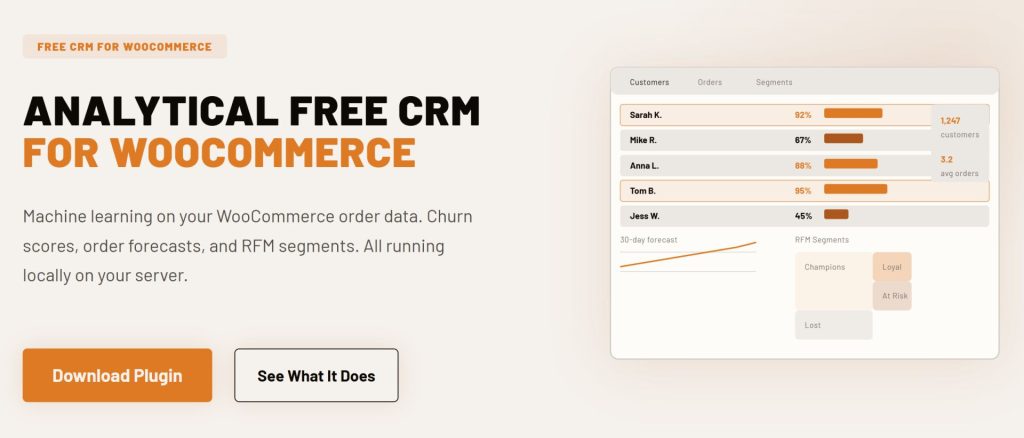
I will start with CRMlytics because it takes the most unusual approach. It is an analytical CRM that runs inside WordPress. No paid tiers, no subscription, no contact limits. Instead of building automation workflows, it runs machine learning models on your WooCommerce data to predict what customers will do next. You get churn risk scores (0-100) for every buyer, automatic RFM segmentation, and order forecasts for the next 30, 90, and 180 days. All of this runs on your own server. Your data never leaves your site.
For marketing, CRMlytics includes basic email campaigns that target customers by segment or tag. Every email send gets click tracking that feeds back into customer timelines. It is not a replacement for a full automation platform, but it gives you the data you need to run smarter campaigns. And since it is free with unlimited contacts and orders, there is no downside to installing it alongside your other tools.
Best for: Store owners who want predictive analytics without paying for enterprise SaaS pricing. If you need to know who is about to churn and who your best customers are, this is the tool.
Pricing: 100% free. Unlimited contacts, unlimited orders. Available on WordPress.org.
2. FluentCRM
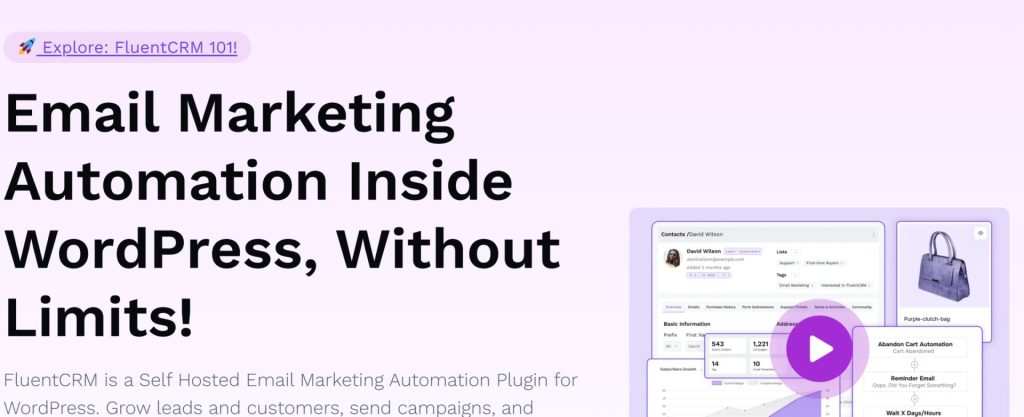
FluentCRM has over 80,000 active installations and a 4.8 rating on WordPress.org. That makes it the most popular native email marketing CRM on the platform. It runs on your server with no contact limits on the paid plan. The WooCommerce integration pulls in purchased products, categories, order count, total spent, and lifetime value. Automation triggers fire on purchase events, refunds, and subscription changes.
FluentCRM’s visual automation builder supports conditional branching, time delays, A/B testing for subject lines, and dynamic segments that update in real time. You also get revenue attribution, so you can see which campaigns actually drove sales. The free version is decent for testing. The paid plan is where the real power lives.
Best for: WooCommerce stores that need sophisticated email automation inside WordPress without monthly SaaS fees.
Pricing: Free version available. Pro starts at $103/year (first year) for one site with unlimited contacts. Available on WordPress.org.
3. FunnelKit Automations
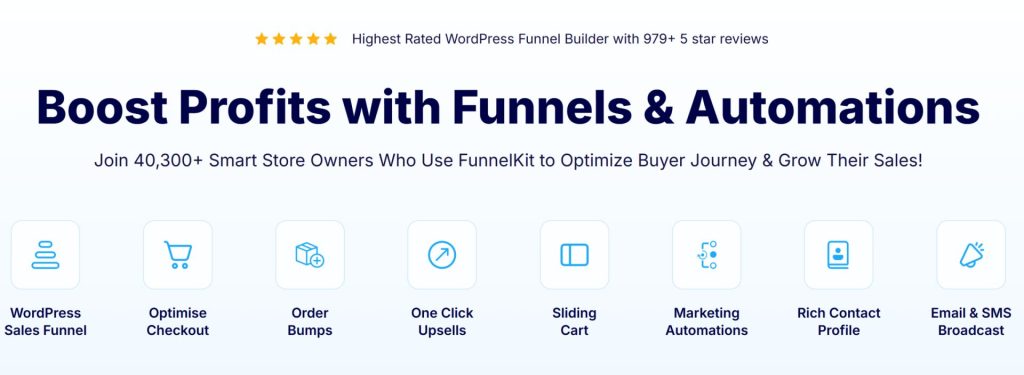
FunnelKit Automations (formerly Autonami) comes in with over 979 five-star reviews and a 4.9 rating on WordPress.org. It was built for WooCommerce from the start, not bolted on later. It understands order bumps, one-click upsells, checkout behavior, and HPOS (High-Performance Order Storage) natively.
What sets it apart: abandoned cart recovery with customizable email sequences and post-purchase upsell flows. The visual automation builder handles complex branching logic. The Pro version adds SMS marketing, broadcast campaigns, and A/B testing. Contact profiles show purchase history, lifetime value, and order frequency. If your main problem is people adding to cart and never buying, this is the tool to try.
Best for: Stores where abandoned cart recovery and post-purchase revenue optimization are the top priorities.
Pricing: Free Lite version available. Standalone Automations Pro starts at $99.50/year. Full bundle with Funnel Builder starts at $249.50/year. Available on WordPress.org.

4. MailPoet
MailPoet has over 500,000 active installations and a 4.4 rating on WordPress.org. Automattic (the company behind WooCommerce) owns it, so the integration is as official as it gets. The free plan covers up to 1,000 subscribers with automated WooCommerce emails for abandoned cart recovery, first purchase follow-ups, and product category-based campaigns.
MailPoet also lets you customize WooCommerce transactional emails using its drag-and-drop builder so your order confirmations and shipping notifications match your brand. The sending service handles deliverability on your behalf, so you do not need a separate SMTP plugin. Paid plans unlock multi-condition segmentation, advanced analytics, and Google Analytics integration.
Best for: Store owners who want email marketing and transactional email customization inside WordPress without managing their own email sending infrastructure.
Pricing: Free up to 500 subscribers (with MailPoet Sending Service) or 1,000 subscribers (self-sent). Business starts at $10/month. Available on WordPress.org.

5. Klaviyo
Klaviyo is the dominant e-commerce marketing platform for D2C brands. Over 65,000 brands use it, and it has a 4.5 rating on G2 from over 7,000 reviews. The WooCommerce integration syncs customer data in real time and supports segmentation by purchase history, product views, and browsing behavior. Pre-built flow templates handle abandoned cart, post-purchase, and win-back campaigns out of the box.
Klaviyo’s predictive analytics (customer lifetime value and churn probability) are locked behind higher tiers, but the core segmentation and automation features are excellent even on the lower paid plans. The revenue attribution reporting is best-in-class. You see exactly how much revenue each email and SMS campaign generated. The downside is pricing: it scales aggressively by contact count. At 50,000 profiles, the email plan costs $720/month.
Best for: E-commerce brands where email drives a large percentage of revenue and the ROI justifies the scaling cost.
Pricing: Free up to 250 profiles and 500 emails/month. Paid email starts at $20/month for 500 contacts. Email+SMS starts at $35/month. WooCommerce integration details.
6. ActiveCampaign
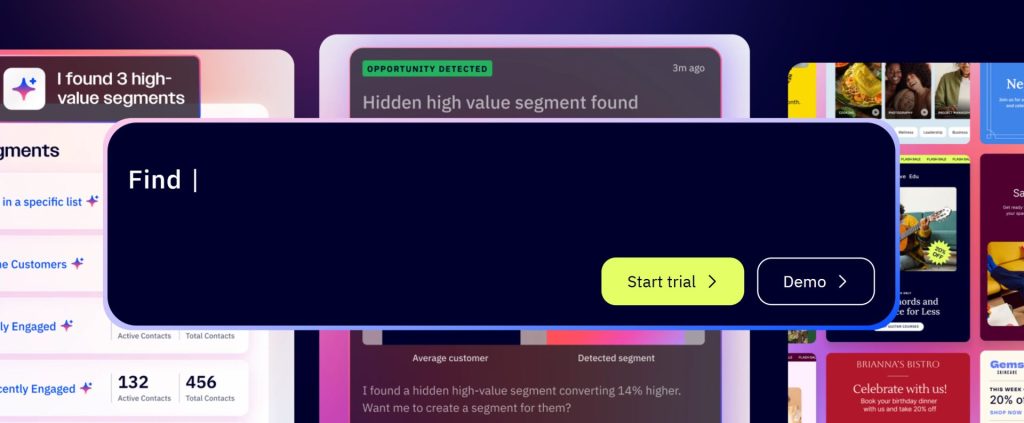
ActiveCampaign serves over 180,000 customers and holds a 4.5 rating on G2 from over 14,000 reviews. It combines marketing automation with a built-in sales CRM, making it a strong choice for stores that have B2B or wholesale components alongside direct retail. The WooCommerce integration syncs contacts, orders, and product data. It also supports browse abandonment tracking to catch customers before they leave.
The visual automation builder is the most powerful in the under-$200/month range, with conditional logic, split paths, and 900+ pre-built automation recipes. ActiveCampaign’s predictive sending feature learns each contact’s open habits and delivers emails at their optimal time. The Plus plan ($49/month at 1,000 contacts) adds CRM pipelines and sales automation, which is valuable if you manage sales reps alongside your email marketing.
Best for: Stores that need advanced marketing automation combined with B2B sales pipeline management.
Pricing: Starter from $15/month (1,000 contacts). Plus from $49/month. Pro from $79/month. Prices scale with contact count. Annual billing required. WooCommerce integration details.
7. Drip
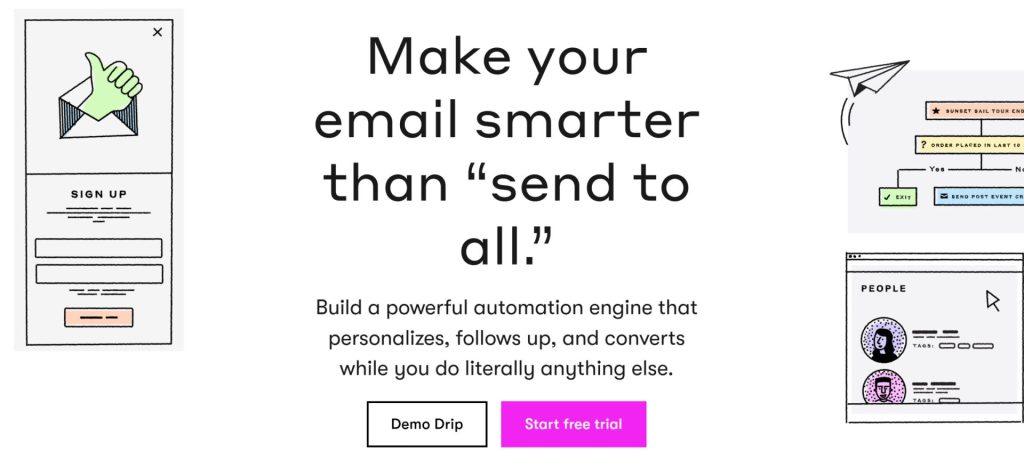
Drip targets online stores specifically. What I like about their approach: one plan unlocks every feature at every tier. You do not pay more to get A/B testing or advanced segmentation. Pricing scales by contact count starting at $39/month for up to 2,500 contacts with unlimited email sends.
The WooCommerce integration pulls in purchase data, order history, and revenue attribution. You can segment by total spend, purchase frequency, product categories, and RFM values. The visual workflow builder has pre-built playbooks for welcome series, abandoned cart recovery, and win-back campaigns. Onsite campaigns let you add pop-ups and lead capture forms directly to your store.
Best for: Mid-size e-commerce brands ($500K to $10M) that want all marketing features included without tier-based gates.
Pricing: $39/month (2,500 contacts), $89/month (5,000), $154/month (10,000). No free plan (14-day trial). WooCommerce integration details.
8. Brevo
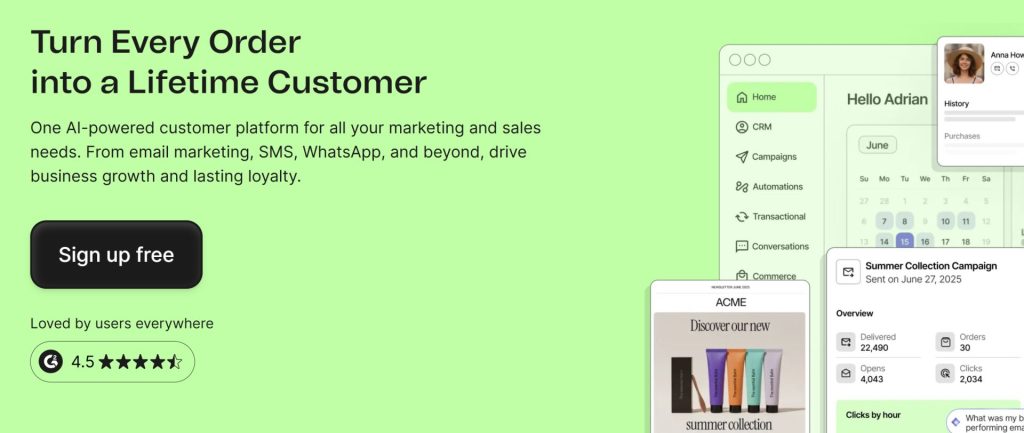
Brevo (formerly Sendinblue) serves over 500,000 customers and has a 4.4 rating on G2. Its pricing model is unique: you pay by email volume rather than contact count. This makes it dramatically cheaper than contact-based CRMs if you have a large list that you email infrequently. You can store unlimited contacts for free on every plan.
The WooCommerce integration syncs customers, orders, and products in real time. Brevo’s marketing features include email, SMS, WhatsApp, and live chat in one platform. The Standard plan ($18/month) adds marketing automation with A/B testing and web event tracking. The Professional plan ($499/month) unlocks contact scoring with RFM analytics, AI segmentation, and advanced ecommerce features like product recommendations and back-in-stock alerts.
Best for: Budget-conscious stores with large lists because the volume-based pricing saves significantly compared to per-contact models.
Pricing: Free (300 emails/day, unlimited contacts). Starter from $9/month. Standard from $18/month. Pro from $499/month. WooCommerce integration details.
9. HubSpot
HubSpot is the largest CRM on this list with over 288,000 customers and $3.1 billion in annual revenue. The free CRM includes up to 1,000,000 contacts with contact management, deal tracking, and live chat. For WooCommerce, you connect through the official HubSpot for WooCommerce plugin by MakeWebBetter or through third-party connectors.
The free plan covers basic contact sync, abandoned cart tracking, and form integration. But the real marketing power comes in the paid tiers. Marketing Hub Starter ($20/month) removes branding and adds simple automation. Marketing Hub Professional ($890/month) unlocks advanced workflows, A/B testing, predictive lead scoring, and custom reporting. The jump from Starter to Professional is steep, so HubSpot makes the most sense for stores that are already growing fast or have a sales team alongside their e-commerce operation.
Best for: Growth-stage stores with B2B sales teams that need the full ecosystem of marketing, sales, and service tools.
Pricing: Free CRM (up to 1M contacts). Starter from $20/month. Pro from $890/month (plus mandatory onboarding fees). WooCommerce integration details.
The Combo Play: FunnelKit + CRMlytics
Here is something I have seen work really well. Instead of picking one CRM that tries to do everything, some store owners pair two native WordPress tools that each excel in their own area. The combo is FunnelKit Automations for marketing execution and CRMlytics for analytics depth.
FunnelKit handles the execution side. It recovers abandoned carts, sends post-purchase upsell sequences, runs email automation workflows, and manages SMS campaigns. These are the tools that directly drive revenue from your existing traffic. Marketers can see exactly how much revenue each campaign recovered and which upsell sequences are performing best.
CRMlytics provides the intelligence layer. It analyzes your entire order history and tells you which customers are about to churn, which segments drive the most lifetime value, and how many orders each customer is expected to place in the next 30, 90, and 180 days. You take these insights and build targeted segments in FunnelKit to act on them.
The practical workflow looks like this: CRMlytics identifies your “Critical” churn risk customers. You create a segment of those customers in CRMlytics, export the list, import it into FunnelKit as a tagged segment, and fire a win-back automation sequence. The whole thing runs on your own server with zero monthly subscription fees.
Both plugins are native WordPress tools available on WordPress.org. FunnelKit starts at $99.50/year. CRMlytics is free. Together they cost less in a year than one month of Klaviyo at 10,000 contacts.
How to Choose the Right Marketing CRM for Your Store
Your choice depends on your budget, your marketing needs, and how much analytics depth you require. Here is a quick decision guide:
- Budget under $15/month: Start with CRMlytics (free) for analytics and MailPoet (free up to 500 subscribers) for basic email marketing. Upgrade MailPoet to the Business plan ($10/month) when you grow past 500 subscribers.
- Native WordPress preferred: FluentCRM is the best all-around native option at $103/year with unlimited contacts. Pair it with CRMlytics if you want predictive analytics.
- Abandoned cart is your biggest problem: FunnelKit Automations is the most focused tool for recovering lost sales. Add CRMlytics for the analytics side.
- Email drives most of your revenue: Klaviyo is the premium choice if the ROI justifies the scaling cost. The segmentation and revenue attribution are best-in-class.
- You need B2B sales pipelines too: ActiveCampaign gives you marketing automation plus sales CRM in one platform.
- Large list, small budget: Brevo charges by email volume, not contacts, so you can store unlimited profiles without paying more.
- Growing fast with a sales team: HubSpot scales with you, but budget for the jump from Starter to Professional when you need advanced automation.
Final Thoughts
The best marketing CRM for WooCommerce features integration depends on what you need most. If you want deep analytics and predictive data, CRMlytics is the only free option that delivers. If you need sophisticated email automation, FluentCRM or ActiveCampaign handle that well. If lost carts are bleeding revenue, FunnelKit is the specialist. And if you have the budget for a premium platform with best-in-class segmentation, Klaviyo is the market leader for a reason. No matter which you choose, focus on finding the best marketing CRM for WooCommerce features integration for your specific store size and budget.
The stores getting the most out of their data are running two tools, not one. An operational CRM handles what to send: email sequences, cart recovery, automation workflows. An analytical CRM handles who to send it to: churn predictions, customer segments, order forecasts. This is standard practice at scale. Klaviyo pairs with Metorik. ActiveCampaign pairs with Google Analytics. HubSpot pairs with its own reporting add-ons.
For WooCommerce, the native version of that pattern is CRMlytics for the intelligence layer and FunnelKit Automations for the execution layer. CRMlytics runs predictive models locally and identifies segments like “At-Risk” or “Champions” on your own server. FunnelKit picks those up and triggers the retention campaigns. Your customer data never leaves WordPress. Start with the free tools first, see what your data actually looks like, then decide where to invest.