Best WooCommerce Customer Management Plugins & CRM in 2026
If you run a WooCommerce store, you already know the problem. Customers come in, some buy once, some buy again, and a lot of them just disappear without you ever knowing why. WooCommerce gives you order reports, but it will not tell you who is about to stop buying, who your most valuable customers are, or where you should put your marketing budget next.
A good CRM plugin changes that. It takes your WooCommerce data and turns it into something useful. It tracks interactions, segments your audience by what they actually do, and helps you send the right message at the right time.
There are two types of WooCommerce CRM plugins. Operational CRMs automate everyday tasks like email sequences, abandoned cart recovery, and workflow automation. Analytical CRMs focus on understanding customers through data, predictive analytics, and scoring models. Some tools sit somewhere in the middle.
This guide covers 11 of the best options in 2026. We tested each one on WooCommerce integration depth, contact management, segmentation, pricing, and the quality of insights they provide. CRMlytics, our own plugin, is included. We have been honest about where it fits and where it does not.
What to Look for in a WooCommerce CRM
Here is what we looked at when evaluating each plugin. These are the features that actually matter for a WooCommerce store.
WooCommerce Integration Depth
The plugin should sync orders, customers, and products automatically. The best integrations go deeper and track refunds, subscriptions, order status changes, and customer browsing behavior. A shallow integration that only syncs contact names is not enough.
Contact Management and Timeline
Every CRM should give you a complete view of each customer. That means seeing their order history, total spend, average order value, and every interaction they have had with your store. A unified timeline that combines orders, email clicks, support notes, and manual activities is the gold standard.
Segmentation and Tagging
You cannot treat all customers the same. Look for tools that let you build segments based on purchase behavior, dates, monetary value, and custom fields. Smart tagging that updates automatically as customer behavior changes saves hours of manual work.
Analytics and Predictive Intelligence
Basic CRMs show you what happened. Good ones show you what is likely to happen next. RFM scoring, churn prediction, health scores, and order forecasting turn your historical data into insights you can actually use. This is the main thing that separates different WooCommerce CRM plugins in 2026.
Self-Hosted vs Cloud/SaaS
Self-hosted plugins run inside your WordPress installation. Your data never leaves your server. Cloud CRMs sync your data to external servers and charge monthly fees that grow with your contact list. Self-hosted gives you data control and flat pricing. Cloud gives you lower setup complexity and usually more features out of the box.
Pricing Model
Pricing varies a lot. Some plugins are completely free. Others charge per contact per month. Some use flat annual pricing no matter your list size. The total cost over three years can differ by thousands of dollars depending on which model you pick.
1. CRMlytics: Best Free Analytical CRM with Predictive ML
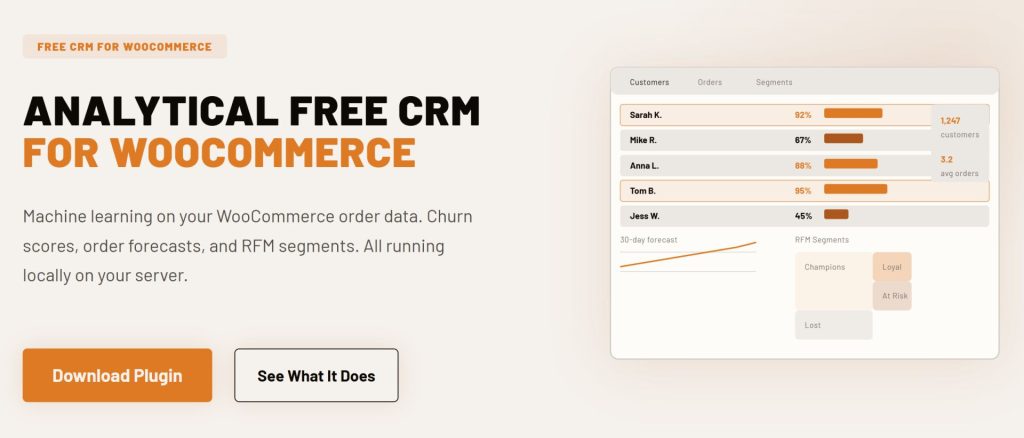
CRMlytics is a free, self-hosted CRM built specifically for WooCommerce. It exists because none of the other WooCommerce CRM plugins offered predictive analytics that run entirely on your own server without monthly subscription fees.
Key Features
- BG/NBD churn prediction uses a well-established statistical model to calculate the probability that each customer is still active. It learns from your entire order history, not from static rules.
- RFM scoring automatically ranks every customer from 1 to 5 on Recency, Frequency, and Monetary value. Customers are grouped into segments like Champions, Loyal, At Risk, and Lost.
- Health scores from 0 to 100. Repeat buyers get a score based on their BG/NBD alive probability. New customers start around 80 and decay if they do not return.
- Order forecasting predicts how many orders each customer will place in the next 30, 90, and 180 days so you know who is worth your marketing spend.
- Smart tags and custom segments let you build dynamic audiences based on behavior, scores, and purchase data.
- Email campaigns let you send to any segment or tag directly from the plugin. Clicks feed back into each customer’s timeline.
- Customer timeline shows every interaction: orders, email clicks, tag changes, manual notes, and phone calls in one chronological feed.
- CSV export for any segment to use in external tools.
Pricing
Completely free. No paid tiers, no contact limits, no data sent outside your server. It is available on the official WordPress plugin directory.
Best For
WooCommerce store owners who want machine learning powered customer insights without paying monthly subscriptions or sending customer data to third parties. CRMlytics pairs well with operational CRMs like FluentCRM or FunnelKit if you need advanced automation workflows.
Limitations
CRMlytics is an analytical CRM, not a marketing automation platform. It does not have a visual automation builder, abandoned cart recovery, or SMS marketing. It focuses on telling you who to target and when. You will need a separate tool if you want complex multi-step automation sequences.
2. FluentCRM: Best Self-Hosted Marketing Automation
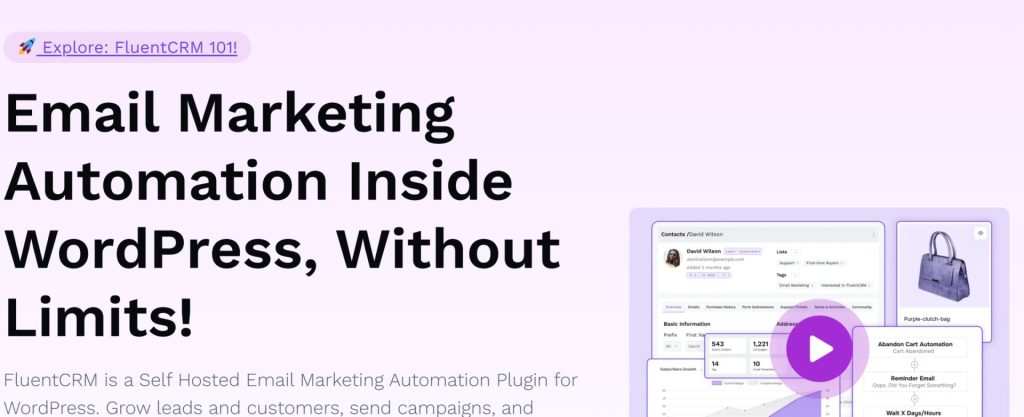
FluentCRM is a self-hosted marketing automation and CRM plugin for WordPress. It has grown fast in the WooCommerce space because it gives you unlimited contacts at a flat annual price with solid WooCommerce integration.
Key Features
- Visual automation builder with triggers for WooCommerce purchases, refunds, subscriptions, and abandoned carts.
- 360 degree contact profiles with complete order history and custom fields.
- Advanced segmentation based on purchase behavior, tags, lists, and custom conditions.
- Email sequences, broadcasts, and smart links for personalization.
- 45+ native integrations with WordPress plugins including WooCommerce, LearnDash, MemberPress, and EDD.
- Abandoned cart recovery with automated email sequences.
- Company module for B2B customer management.
Pricing
Free version available with basic features. Pro starts at $129 per year for a single site (Solo plan), $249 per year for 5 sites (Small Business), and $499 per year for 50 sites (Agency). All plans include unlimited contacts and unlimited email campaigns. You pay only for the plugin license plus whatever your email sending service costs (like Amazon SES at roughly $0.10 per 1,000 emails).
Best For
WooCommerce stores that want full marketing automation with email sequences, abandoned cart recovery, and deep WordPress integration without paying per contact.
3. FunnelKit Automations: Best WooCommerce-First Automation Engine
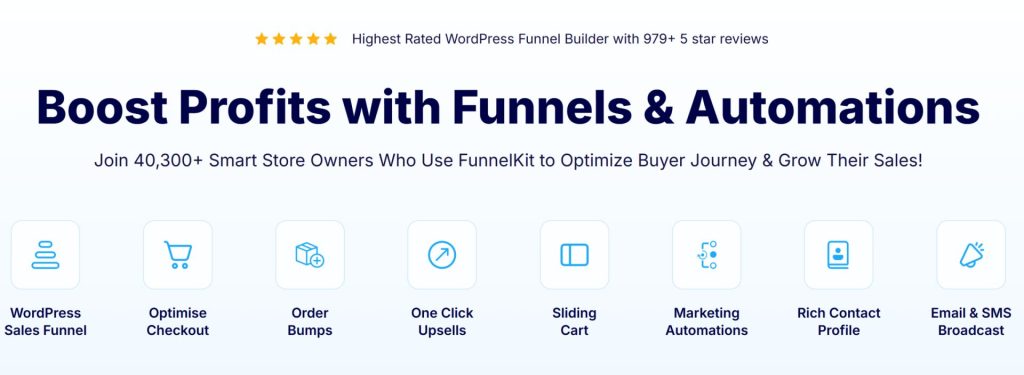
FunnelKit Automations (formerly Autonami) is a WooCommerce-focused marketing automation and CRM plugin. It was built specifically for WooCommerce stores and has one of the deepest order data integrations available in a self-hosted plugin.
Key Features
- Visual workflow builder with WooCommerce specific triggers: order created, order status changed, subscription events, refunds, and customer win-back.
- Built-in CRM with 360 degree contact profiles and full purchase history.
- Abandoned cart recovery with automated email and SMS sequences.
- Post-purchase follow-ups including thank you emails, upsell offers, and review requests.
- WooCommerce specific actions: create coupons, change order status, add order notes, and send transactional emails.
- Broadcast emails and SMS campaigns with advanced segmentation.
- Drag-and-drop email builder with WooCommerce product blocks.
Pricing
FunnelKit Automations standalone starts at $99.50 per year for a single site. The Professional plan ($249.50 per year) bundles Automations Pro with Funnel Builder for a complete sales and marketing stack. A free Lite version is available on WordPress.org with basic automation capabilities.
Best For
WooCommerce stores that want a unified platform for sales funnels and marketing automation. FunnelKit is particularly strong for stores that rely on abandoned cart recovery and post-purchase sequences to drive revenue.
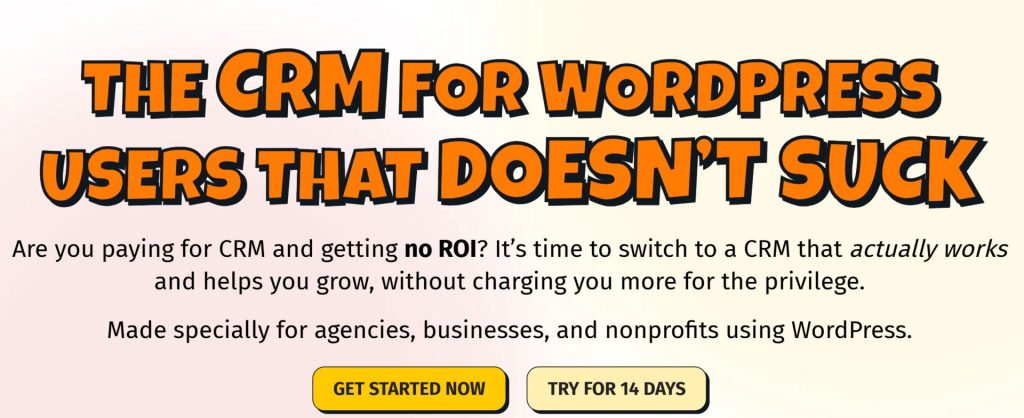
4. Groundhogg: Open Source CRM with Flat-Rate Pricing
Groundhogg is an open-source, self-hosted CRM and marketing automation plugin for WordPress. Its main selling point is flat-rate pricing that never goes up when your contact list grows.
Key Features
- Visual flow (automation) builder with drag-and-drop steps.
- Native WooCommerce integration for order events, status changes, and cart activities.
- Dynamic coupon generation and personalized discount codes within automations.
- Contact segmentation by order history, lifetime value, and total orders.
- Email broadcasts and automated sequences.
- 45+ extensions for additional integrations including WooCommerce, LearnDash, AffiliateWP, and Elementor.
- Replacement codes for personalized email content using customer data.
Pricing
Free version available on WordPress.org. Paid plans start at $20 per month (Basic), $40 per month (Plus), and $50 per month (Pro). All paid plans include unlimited contacts. The WooCommerce integration extension is part of the paid plans. Groundhogg grandfathers pricing, so your rate stays the same as long as you keep renewing.
Best For
WooCommerce stores that want open-source software, unlimited contacts at a flat price, and a visual automation builder without per-contact fees.
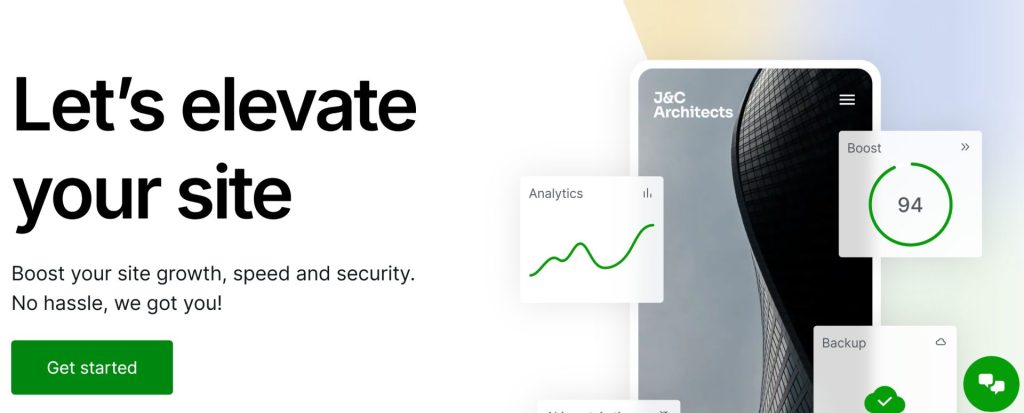
5. Jetpack CRM: Free CRM from the WordPress Parent Company
Jetpack CRM (formerly Zero BS CRM) is developed by Automattic, the company behind WordPress.com and WooCommerce. It offers a free core CRM with WooCommerce sync and paid extensions for advanced features.
Key Features
- Free WooCommerce sync module (WooSync) that automatically creates customer records from orders.
- Contact management with custom fields, tags, and notes.
- Invoice and quote management for billing customers directly.
- Transaction tracking with payment gateway integration (PayPal, Stripe via paid extensions).
- Basic segmentation through tags and custom filters.
- CSV import and export for data migration.
Pricing
Free core plugin available on WordPress.org. Pro starts at $11 per month (billed annually) for access to paid extensions including advanced WooCommerce sync, Stripe integration, Mailchimp sync, and more. Most features that WooCommerce stores need require one or more paid extensions.
Best For
Small WooCommerce stores, freelancers, and consultants who need basic contact management and invoicing alongside their WooCommerce data at a low cost.
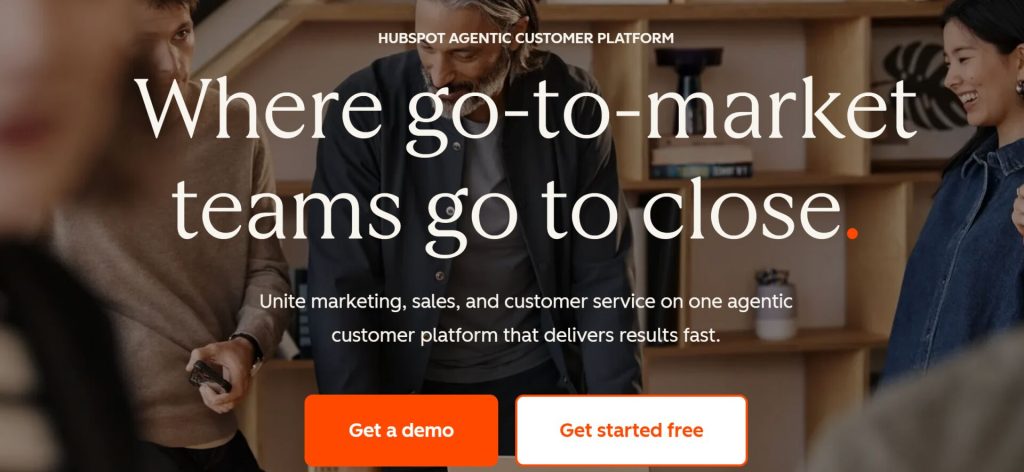
6. HubSpot for WooCommerce: Free Enterprise-Grade CRM Sync
HubSpot is one of the most popular CRM platforms around. Its official WooCommerce plugin (by MakeWebBetter) syncs customers, orders, and products to HubSpot’s cloud CRM. The free tier is generous, but costs ramp up fast as your needs grow.
Key Features
- Free WooCommerce sync plugin that creates and updates contact records automatically.
- Real-time sync of orders, products, and customer data.
- Abandoned cart recovery (via HubSpot workflows).
- Email marketing, landing pages, and form builders included in the free CRM.
- Sales pipeline management for B2B or wholesale operations.
- 7 built-in ecommerce reports.
- Live chat and chatbot functionality.
Pricing
The WooCommerce integration plugin is free. HubSpot CRM starts free for unlimited contacts with basic features. Marketing Hub starts at $20 per month for 1,000 marketing contacts and goes up to $450 per month for higher tiers. Costs increase significantly as your contact list grows and as you need more advanced features.
Best For
WooCommerce stores that already use HubSpot or want a full sales, marketing, and service platform in one cloud ecosystem. Best suited for stores with team-based sales processes or B2B/wholesale operations.

7. Klaviyo: Best for Email & SMS Marketing with Ecommerce Data
Klaviyo gets called an email marketing platform, but its data model is built around ecommerce customer profiles. For thousands of D2C brands, it works as a de facto CRM. Klaviyo’s predictive analytics (predictive CLV, churn prediction) hold up against enterprise tools at a fraction of the cost.
Key Features
- Ecommerce-first data model that automatically tracks purchase behavior, browsing activity, and email engagement.
- Predictive analytics including expected CLV, churn risk scores, and predicted purchase dates.
- Advanced segmentation based on any combination of behavioral and profile data.
- Visual email and SMS flow builder with conditional logic.
- Abandoned cart recovery, browse abandonment, and post-purchase flows.
- A/B testing for subject lines, content, and send times.
- Built-in reporting with revenue attribution per campaign.
Pricing
Free plan available up to 250 contacts (with 500 email sends per month). Paid plans start at approximately $20 per month for up to 500 contacts and scale with your contact list size. SMS credits are charged separately. Klaviyo uses a contact-based pricing model, so your monthly cost increases as your list grows.
Best For
Direct-to-consumer WooCommerce brands that prioritize email and SMS revenue and need sophisticated behavioral segmentation and predictive analytics.
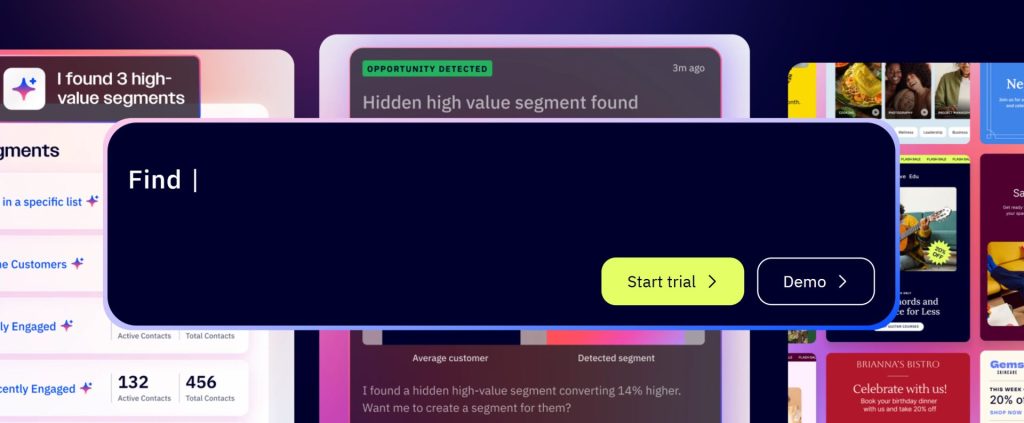
8. ActiveCampaign: Sophisticated Automation at Mid-Range Pricing
ActiveCampaign is a cloud-based marketing automation and CRM platform with a solid WooCommerce connector. It has one of the most capable automation builders at its price point, with conditional logic, predictive sending, and split paths.
Key Features
- Visual automation builder with if/then branching, split paths, and goal-based triggers.
- Native WooCommerce integration for abandoned cart recovery, browse abandonment, and post-purchase automations.
- Predictive sending that optimizes send times per individual contact.
- Lead scoring and deal tracking for sales pipelines.
- Conditional content in emails based on customer data and behavior.
- Built-in CRM with contact scoring and pipeline management.
- Integrations with 870+ apps via native connectors and Zapier.
Pricing
Starts at $15 per month for the Lite plan (up to 1,000 contacts). Plus plan starts at $49 per month. Higher tiers go up to $159 per month for Enterprise. All pricing scales with contact count. The WooCommerce integration is available on the Plus plan and above.
Best For
Small to medium WooCommerce stores that need advanced automation capabilities (conditional logic, predictive sending) without paying for enterprise-tier HubSpot pricing.
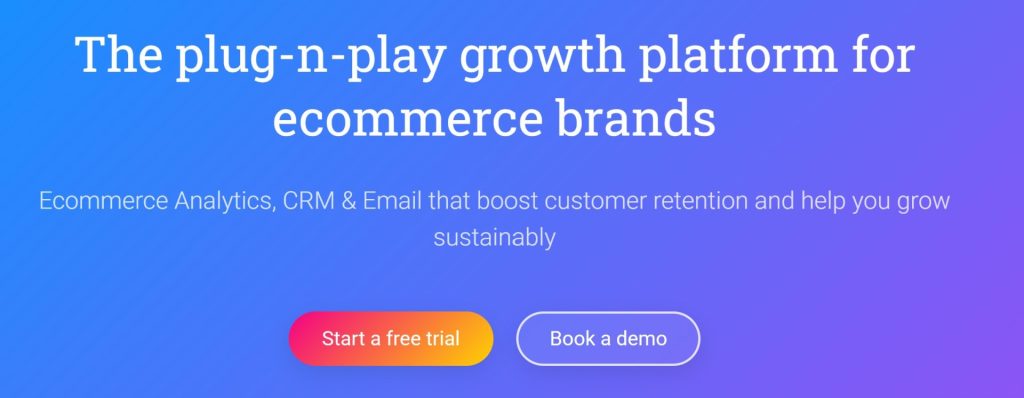
9. Metrilo: Ecommerce Analytics with Integrated CRM
Metrilo started as a pure analytics tool and later expanded into CRM and email marketing. It is a cloud-based platform that offers cohort analysis, customer lifetime metrics, and product performance reporting alongside its CRM features.
Key Features
- Ecommerce analytics with conversion funnels, product performance reports, and real-time dashboards.
- Retention analysis with cohort comparisons and customer lifetime metrics.
- Customer database with filtering and behavioral segmentation.
- Individual customer profiles with complete order history.
- Email marketing with drag-and-drop editor and automation rules (Premium plan).
- Customer feedback surveys sent automatically after purchase.
- Sales recovery tools to identify and target intended purchases that did not complete.
Pricing
Three plans. Essential at $199 per month (ecommerce analytics only). Pro at $379 per month (adds CRM and retention analysis). Premium from $599 per month (adds email marketing and automation). Annual billing reduces costs to $165, $315, and $499 per month respectively. A 14-day free trial is available on all plans.
Best For
Data-driven WooCommerce stores that want deep analytics, cohort analysis, and CRM in one cloud platform and have the budget for monthly SaaS pricing.

10. Zoho CRM: Highly Customizable Budget-Friendly CRM
Zoho CRM is a mature cloud platform with lots of customization options. It does not have an official first-party WooCommerce integration, but third-party plugins and Zapier connectors fill the gap well enough.
Key Features
- Highly customizable modules, fields, and layouts for any business process.
- Multichannel communication: email, phone, social media, and live chat.
- Sales pipeline management with deal tracking and forecasting.
- Workflow automation with blueprints and approval processes.
- AI-powered sales assistant (Zia) for predictions and recommendations.
- Integrates with WooCommerce via third-party plugins like CRM Perks ($39-$99 per year) or WP Fusion ($247 per year).
- Free tier for up to 3 users.
Pricing
Free tier available for up to 3 users with basic CRM features. Paid plans start at $14 per user per month (Standard) and go up to $65 per user per month (Enterprise). The WooCommerce integration requires a third-party plugin at an additional cost.
Best For
Budget-conscious teams that need a customizable cloud CRM and are willing to invest time in setup and third-party integrations for WooCommerce sync.
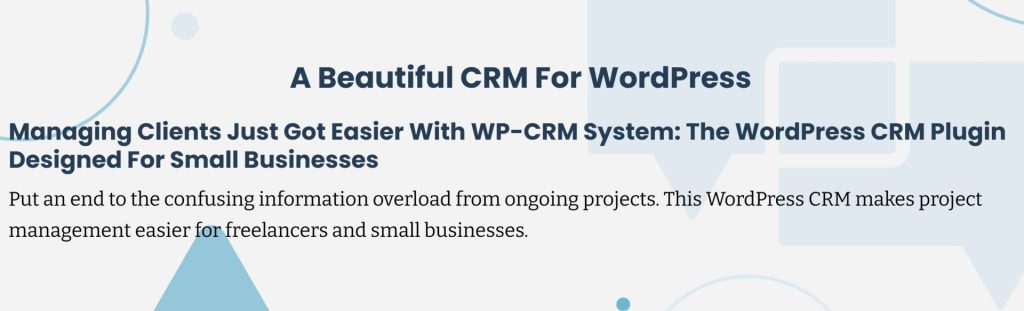
11. WP-CRM System: Lightweight, GDPR-Focused Open Source CRM
WP-CRM System is a lightweight, open-source CRM plugin for WordPress. It goes for speed, privacy compliance, and simplicity over feature bloat. It loads in under 180ms on shared hosting, uses zero external CDNs, and keeps all data on your server.
Key Features
- GDPR dashboard with real-time consent status per contact.
- Auto-generated DSAR (Data Subject Access Request) reports in PDF and CSV formats.
- Built-in anonymization for test environments.
- Contact and interaction management with complete transaction history.
- Enterprise reporting for tracking key metrics across sales, marketing, and recruitment.
- 100% open-source with no third-party cloud dependencies.
Pricing
Free and open-source. Available on WordPress.org with no paid tiers or upsells.
Best For
WooCommerce stores in regulated industries (health, finance, education) that need a highly auditable, privacy-compliant CRM and do not need advanced marketing automation.
Side-by-Side Comparison
Here is all 11 plugins side by side.
| Plugin | Self-Hosted | Free Tier | Predictive Analytics | Automation | Starting Price |
|---|---|---|---|---|---|
| CRMlytics | Yes | Full plugin | Yes (BG/NBD, RFM) | Basic email | Free |
| FluentCRM | Yes | Lite version | No | Full | $129/yr |
| FunnelKit Automations | Yes | Lite version | No | Full | $99.50/yr |
| Groundhogg | Yes | Core plugin | No | Full | $20/mo |
| Jetpack CRM | Yes | Core plugin | No | No | Free / $11/mo Pro |
| HubSpot | No | Yes | Basic | Full | Free / $20/mo+ |
| Klaviyo | No | Up to 250 contacts | Yes (CLV, churn) | Full | Free / $20/mo+ |
| ActiveCampaign | No | No | Basic | Full | $15/mo |
| Metrilo | No | 14-day trial | Basic | Premium plan | $199/mo |
| Zoho CRM | No | Up to 3 users | Basic (Zia AI) | Full | Free / $14/user/mo |
| WP-CRM System | Yes | Full plugin | No | No | Free |
How to Choose the Right CRM for Your WooCommerce Store
Picking the right one comes down to three questions.
Question 1: Do You Need Predictive Analytics or Marketing Automation?
This matters more than anything else. If you mainly need to understand customer behavior, predict churn, and find high-value segments, an analytical CRM like CRMlytics is the right call. If you mainly need to send automated email sequences and recover abandoned carts, an operational CRM like FluentCRM or FunnelKit works better. A lot of stores use both one for intelligence, one for execution.
Question 2: Do You Want Your Data On Your Server or in the Cloud?
Self-hosted plugins (CRMlytics, FluentCRM, FunnelKit, Groundhogg, Jetpack CRM, WP-CRM System) keep all customer data inside your WordPress database. Nothing leaves your server. Cloud CRMs (HubSpot, Klaviyo, ActiveCampaign, Metrilo, Zoho) sync your data to external servers and charge monthly fees that grow with your contact list. Neither option is wrong, but the tradeoff between data control and feature depth is real.
Question 3: What Is Your Total Cost Over Three Years?
A free plugin like CRMlytics costs nothing no matter how big your customer list gets. FluentCRM at $129 per year is $387 over three years. HubSpot for 5,000 contacts can run over $3,600 per year. Klaviyo for 5,000 contacts is roughly $1,800 per year. Metrilo Pro for 5,000 contacts comes to $3,780 per year. When you compare WooCommerce CRM plugins, always work out the three-year total based on where your list is heading.
Quick Recommendations by Store Profile
- Startup (under 100 orders/month, limited budget): CRMlytics for analytics + FunnelKit Lite for automation. Total cost: $0.
- Growing store (100-1,000 orders/month): CRMlytics for predictive insights + FluentCRM Pro for automation. Total cost: $129/year.
- Established store (1,000+ orders/month, D2C focus): Klaviyo for email/SMS automation + CRMlytics for on-server analytics. Total cost: $20-$200/month depending on list size.
- B2B/Wholesale operation: HubSpot for sales pipeline management + CRMlytics for customer health scoring. Total cost: Free to $450/month.
- Regulated industry (health, finance): WP-CRM System for compliance + CRMlytics for analytics. Total cost: $0.
Final Thoughts
The WooCommerce CRM space has more good options in 2026 than ever before. The biggest change from previous years is self-hosted analytical CRMs like CRMlytics that bring machine learning predictions directly into your WordPress installation without recurring costs.
The right choice depends on your store size, your technical comfort level, and whether you prioritize data ownership or feature breadth. If you are just getting started, the combination of a free analytical CRM like CRMlytics with a free marketing automation plugin like FunnelKit Lite gives you a complete customer management stack for zero upfront investment.
As your store grows, you can add more specialized tools. The important thing is to start. Even basic CRM usage can improve retention and revenue. Your WooCommerce data already knows which customers are about to leave and who your best buyers are. You just need the right tool to see it.
CRMlytics is a free WooCommerce CRM plugin available on WordPress.org. It provides predictive analytics, RFM scoring, churn prediction, and order forecasting with no monthly fees and no data leaving your server. Download CRMlytics for free.