WooCommerce CRM Integration: 20 Platforms That Actually Work with Your Store
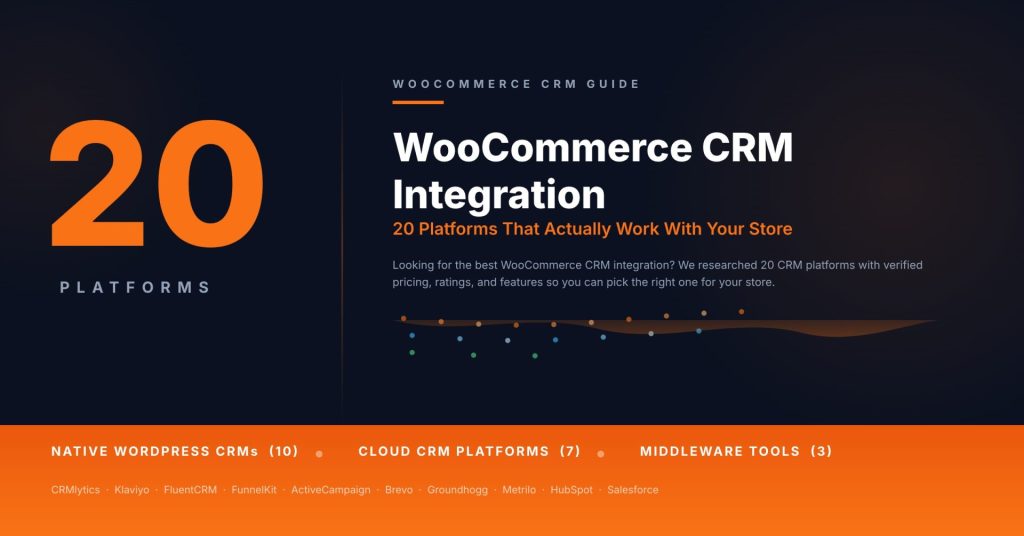
Your WooCommerce store collects customer data with every order. Names, emails, purchase histories, and product preferences all pile up in your database. But that data sits there doing nothing unless you connect it to a system that helps you act on it. That is exactly what a WooCommerce CRM integration does. It links your store to a customer relationship management platform so you can see who your customers are, what they buy, and when they need attention.
The challenge is there are dozens of options, and they work in very different ways. Some are native WordPress plugins that read your WooCommerce data directly from your database. Others are cloud platforms that sync your store data to external servers. And some are middleware tools that bridge the gap between WooCommerce and a CRM you already use. I spent weeks researching 20 different CRM platforms that connect to WooCommerce. I looked at pricing pages, WordPress.org ratings, G2 reviews, and active installation counts. Every number in this article comes from verified sources as of June 2026.
What to Look for in a WooCommerce CRM Integration
Before I get into the individual tools, here is how I evaluated each option. These four criteria matter more than flashy feature lists when choosing a WooCommerce CRM integration.
- Integration depth. Does the plugin read your order data natively from your WordPress database, or does it need a third-party connector? Native integration means fewer things break after WooCommerce updates.
- Pricing model. Per-contact pricing is the most common trap. A store with 30,000 customers can end up paying thousands per year. Flat-rate, per-email, and free models are much more predictable as your list grows.
- Data ownership. Native WordPress plugins keep everything on your server. Cloud tools sync data externally. This affects your privacy compliance and what happens if you cancel your subscription.
- Features that match your need. Some plugins focus on email automation. Others focus on predictive analytics or sales pipelines. The best WooCommerce CRM integration is the one that solves your actual problem, not the one with the longest feature list.
Comparison Table: 20 CRM Platforms at a Glance
Use this table to narrow down your options before reading the detailed breakdowns. I verified every entry against each tool’s official site as of June 2026.
| CRM | Type | Starting Price | Free Tier | Automation | Analytics | Rating |
|---|---|---|---|---|---|---|
| CRMlytics | Native WP | Free | Full product | Basic campaigns | Predictive | 5/5 (WP.org) |
| FluentCRM | Native WP | $129/yr | Limited (no WC sync) | Advanced visual | Basic | 4.8/5 (WP.org) |
| FunnelKit Automations | Native WP | $99.50/yr | Lite (basic WC triggers) | Visual builder | Basic | 4.9/5 (WP.org) |
| AutomateWoo | Native WP | $119/yr | No | 190+ WC triggers | No | 4.6/5 (WC) |
| Jetpack CRM | Native WP | Free | Full core + WooSync | Basic (paid ext.) | Basic | 4.3/5 (WP.org) |
| Groundhogg | Native WP | $240/yr | Core (no WC) | Visual flow editor | Basic | 4.9/5 (WP.org) |
| MailPoet | Native WP | Free | 1K subs, 5K emails/mo | Standard | Basic | 4.4/5 (WP.org) |
| WP ERP | Native WP | Free | Core (WC ext. extra) | Basic | Basic | 4.4/5 (WP.org) |
| Mail Mint | Native WP | $104.99/yr | Limited (no WC) | Visual builder | Basic | 4.7/5 (WP.org) |
| QuillCRM | Native WP | $69/yr | No | Automation builder | Basic | New |
| HubSpot | Cloud | Free | 1K contacts | Paid plans | Basic | 4.4/5 (G2) |
| ActiveCampaign | Cloud | $15/mo | 14-day trial | Advanced | Basic | 4.5/5 (G2) |
| Klaviyo | Cloud | Free | 250 profiles | Advanced | Predictive | 4.6/5 (G2) |
| Drip | Cloud | $39/mo | 14-day trial | Visual builder | No | 4.4/5 (G2) |
| Brevo | Cloud | Free | 300 emails/day | Standard+ | Basic | 4.4/5 (G2) |
| Omnisend | Cloud | Free | 250 contacts | Pre-built flows | Basic | 4.6/5 (G2) |
| Metorik | Cloud | $25/mo | No | Engage add-on | Deep | 4.9/5 (G2) |
| WP Fusion | Middleware | $297/yr | No | Tag-based | No | 5/5 (site) |
| Zapier | Middleware | Free | 100 tasks/mo | Multi-step Zaps | No | 4.7/5 (G2) |
| Uncanny Automator | Middleware | Free | Basic recipes | Recipe builder | No | 4.8/5 (WP.org) |
I organized the tools by how they connect to WooCommerce so you can compare similar options side by side.
Category 1: Native WordPress CRM Integrations
Native WordPress CRM plugins install from your dashboard and run on your own server. They read WooCommerce orders and customers directly from your database. No API keys, no third-party accounts, and no data that leaves your server. If data sovereignty matters to you, start with this category.
1. CRMlytics
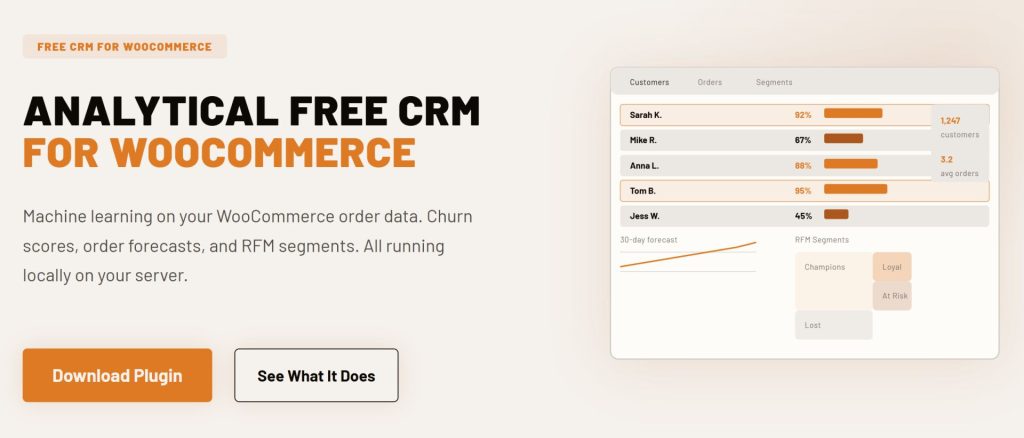
CRMlytics is the only completely free analytical CRM built specifically for WooCommerce. It runs machine learning models directly on your server to calculate a health score from 0 to 100 for every customer. Customers below 40 are at critical risk of churning. The plugin also predicts how many orders each customer will place in the next 30, 90, and 180 days.
RFM scores (Recency, Frequency, Monetary) are calculated automatically and customers get sorted into segments like Champions, Loyal, At Risk, and Lost. You can build custom segments by stacking rules based on order count, average order value, health score, and purchase dates. The plugin includes built-in email campaigns with click tracking, color-coded smart tags that update automatically, customer timelines, custom fields, and one-click CSV export. Everything runs on your own server with no cloud sync. CRMlytics has been tested on stores with over 200,000 orders and 15,000 customers with zero storefront impact.
- Pricing: 100% free. No paid tiers, no contact limits, no upsells.
- Best for: Store owners who want predictive analytics without paying per contact or sending data to third parties. Pairs well with an operational CRM like FluentCRM or FunnelKit for email automation.
2. FluentCRM
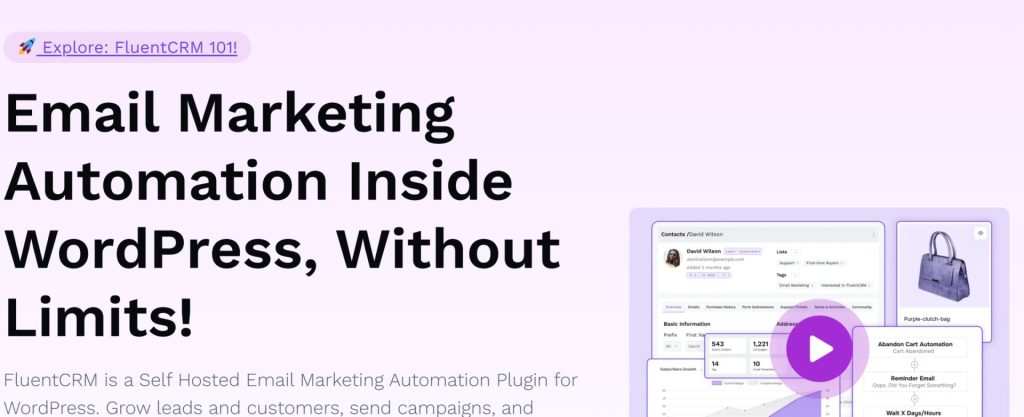
FluentCRM is the most popular self-hosted CRM in the WordPress ecosystem with over 80,000 active installations and a 4.8 out of 5 rating on WordPress.org from 240+ reviews. The team behind it is WPManageNinja, the same folks who build Fluent Forms. The visual automation builder supports conditional branching, time delays, and A/B testing for subject lines.
One thing people miss: the WooCommerce integration is a Pro feature. The free version handles basic contact management but does not sync WooCommerce customers or purchase data. FluentCRM’s own support team confirmed on their forum that the free version has “very limited syncing functions, mainly basic WordPress user profile sync, but not deep WooCommerce checkout or purchase data integration.” The Pro plan at $129 per year unlocks everything. There are 45+ native integrations with LearnDash, MemberPress, AffiliateWP, and Gravity Forms.
- Pricing: Free version with basic features. Pro starts at $129/yr per site (often discounted to $103 for the first year). Unlimited contacts on all plans.
- Best for: Stores that need advanced email automation and are willing to pay for the Pro tier to unlock WooCommerce triggers.
3. FunnelKit Automations
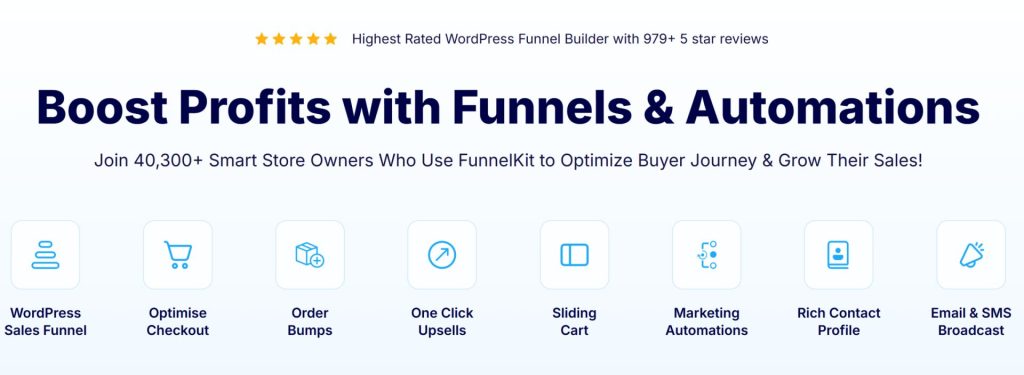
FunnelKit Automations (formerly Autonami) has over 40,000 stores using it and a 4.9 out of 5 rating from 979+ five-star reviews on WordPress.org. The free Lite version includes real WooCommerce triggers: cart abandoned, cart recovered, order created, order status changed, order refunded, and review received. You can build basic abandoned cart sequences without paying anything.
The Pro version at $99.50 per year unlocks 360-degree contact profiles, broadcast campaigns, SMS marketing, advanced segmentation with conditional branching, and 30+ pre-built automation recipes. It supports HPOS (High-Performance Order Storage) for modern WooCommerce setups. A recent update moved WooCommerce customer import from Pro to Lite, making the free version more useful.
- Pricing: Free Lite version. Automations Pro at $99.50/yr. Full suite bundle (includes Funnel Builder) at $249.50/yr.
- Best for: Stores where abandoned carts and upsell opportunities are leaving money on the table.

4. AutomateWoo
AutomateWoo is the official WooCommerce marketing automation extension sold through the WooCommerce.com marketplace. Over 30,000 stores use it. It has 190+ WooCommerce-specific triggers including cart abandonment, order status changes, product purchases, subscription renewals, failed payments, wishlist activity, and membership changes. No other native plugin gets this deep into WooCommerce data.
You combine triggers with rules and actions to build automated workflows. Abandoned cart recovery includes guest customer tracking, which many native plugins cannot do. SMS notifications via Twilio are available as an add-on. AutomateWoo does not include a drag-and-drop email builder. You compose emails using the WordPress editor with HTML support.
- Pricing: $119/yr for a single site. Includes 1 year of updates and support. 30-day refund policy.
- Best for: Stores that want deeply integrated WooCommerce automation from the official marketplace with the most triggers available.
5. Jetpack CRM
Jetpack CRM comes from Automattic, the company behind WordPress.com and WooCommerce. It has 30,000+ active installations and a 4.3 out of 5 rating on WordPress.org. Originally launched as Zero BS CRM in 2016, it keeps a clean interface focused on practical customer management.
The free core includes the WooSync module that pulls WooCommerce orders, customers, and transactions into CRM contact profiles automatically. Automattic’s own documentation says “the free core is fully integrated with WooCommerce using the built-in WooSync module.” You also get invoicing, quote generation, and a client portal where customers can view and pay invoices. Paid extensions add Stripe sync, PayPal sync, Mail Campaigns, and advanced segments.
- Pricing: Free core with WooSync. Freelancer bundle at $11/mo (4 extensions). Entrepreneur bundle at $17/mo (all 30+ extensions, 10 sites, white-label).
- Best for: Small stores and freelancers who need a lightweight CRM with invoicing alongside WooCommerce.
6. Groundhogg
Groundhogg has 2,000+ active installations on WordPress.org and a 4.9 out of 5 rating from 145 reviews. It is fully open source under GPLv3 with the source code on GitHub. Version 4.0 brought a redesigned Flow Editor with drag-and-drop triggers, actions, conditional branching, and A/B testing.
The WooCommerce integration requires the Pro plan at $600 per year ($50/mo). Once on Pro, you get purchase-based segmentation, order history in contact profiles, automation triggers, SMS via Twilio, and WhatsApp messaging. Flat-rate pricing means unlimited contacts and unlimited users at every paid tier. Groundhogg grandfathers pricing, so your rate stays the same as long as you renew.
- Pricing: Free core. Basic at $240/yr. Pro at $600/yr (required for WooCommerce). Agency at $1,200/yr with white-labeling.
- Best for: Developers and agencies who want full source code access and white-label capability.

7. MailPoet
MailPoet has 500,000+ active installations and a 4.4 out of 5 rating on WordPress.org. Automattic owns it. The built-in MailPoet Sending Service delivers a 98.5% deliverability rate, so you do not need a separate SMTP provider. The free Starter plan covers up to 1,000 subscribers and 5,000 emails per month.
For WooCommerce, MailPoet includes abandoned cart recovery emails, first-purchase follow-ups, product recommendation emails, and automated post-purchase sequences. You can segment customers by total spent, order count, country, subscription status, and membership status. The Business plan at $10/mo removes sending limits and adds priority support.
- Pricing: Free for up to 1,000 subscribers and 5,000 emails/mo. Business from $10/mo (500 subscribers, unlimited emails). Agency from $30/mo (up to 50 sites).
- Best for: Small WooCommerce stores that want simple email marketing with good deliverability from inside WordPress.

8. WP ERP
WP ERP by weDevs is the only full ERP system built natively for WordPress. The free core bundles CRM, HR Management, and Accounting modules. It has over 7,000 active installations and a 4.4 out of 5 rating. The WooCommerce Integration extension is a separate paid add-on at $5.99 per month. It syncs customer data, order history, and transactions into both the CRM and accounting modules.
- Pricing: Free core with CRM, HR, and Accounting modules. WP ERP Pro at $9.99/mo plus $3/user. Extensions are a la carte (WooCommerce $5.99/mo, Deals $9.49/mo).
- Best for: Small to medium businesses that need CRM, HR, and accounting managed from one WordPress dashboard.
9. Mail Mint
Mail Mint comes from the WPFunnels team and has 5,000+ active installations with a 4.7 out of 5 rating on WordPress.org. The unique differentiator is the visual canvas integration with WPFunnels, which lets you plan sales funnel pages and email automation flows on the same screen.
The free version covers lead forms, email campaigns, and automation workflows, but WooCommerce integration requires the Starter plan at $104.99 per year. That unlocks customer sync, WooCommerce automation triggers (order placed, order failed, status changed, first order), and abandoned cart recovery with auto-generated coupon codes.
- Pricing: Free version with 500 subscribers and 5,000 emails/mo. Starter at $104.99/yr adds WooCommerce integration.
- Best for: Store owners who already use WPFunnels or want visual funnel and email planning together.
10. QuillCRM
QuillCRM includes sales pipeline management, email marketing, SMS campaigns, and a native WhatsApp Business API integration in one self-hosted WordPress plugin. The Basic plan at $69 per year or $199 lifetime includes unlimited contacts and users, WooCommerce sync with abandoned cart recovery, email campaigns with a drag-and-drop builder, A/B split testing, and an automation builder.
- Pricing: Basic at $69/yr or $199 lifetime. Plus at $139/yr or $299 lifetime. Enterprise at $259/yr or $599 lifetime.
- Best for: Stores that need WhatsApp alongside email and SMS from a single self-hosted plugin.
Category 2: Cloud CRM Platforms with WooCommerce Plugins
Cloud CRM platforms host your data on their servers and connect to WooCommerce through official plugins or third-party connectors. They tend to have the richest marketing automation and multi-channel features, but they come with ongoing monthly costs and your data leaves your server.

11. HubSpot
HubSpot is the most adopted CRM on this list with 288,706 customers as of December 2025 and $3.1 billion in annual revenue. The free CRM tier includes up to 1,000 contacts with unlimited users, deal pipelines, meeting scheduling, and live chat. On G2, HubSpot has a 4.4-star rating from over 10,000 reviews.
The catch for WooCommerce stores is that HubSpot does not have a native WooCommerce integration. You need a third-party connector like the MakeWebBetter HubSpot for WooCommerce plugin (7,000+ active installs) or WP Fusion. Marketing Hub Professional jumps to $890 per month with a mandatory $3,000 onboarding fee. For most WooCommerce-only stores, the cost of this WooCommerce CRM integration gets steep fast.
- Pricing: Free CRM (1,000 contacts). Sales Hub Starter $20/seat/mo. Marketing Hub Professional $890/mo + $3,000 onboarding.
- Best for: Stores already using HubSpot or planning to scale to enterprise marketing operations.
12. ActiveCampaign
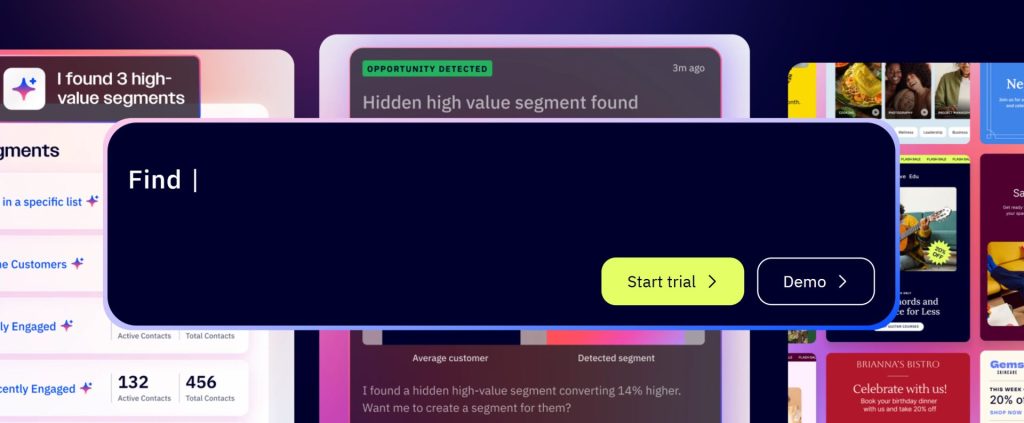
ActiveCampaign has 180,000 customers and a 4.5 rating on G2 from over 14,000 reviews. The visual automation builder is one of the best in the industry for complex conditional logic. The WooCommerce integration is available through an official plugin that syncs customer data, order history, and products in real time.
You can set up abandoned cart sequences, post-purchase follow-ups, and win-back campaigns through the drag-and-drop builder. CRM features like sales pipelines and lead scoring are sold as separate add-ons on Plus plans and above. Since November 2025, ActiveCampaign charges for all contacts including unsubscribed and bounced ones, which can increase your bill if you do not clean your list regularly.
- Pricing: Starter $15/mo (1K contacts, 5 actions per workflow). Plus $49/mo. Pro $79/mo. Enterprise $145/mo. At 10K contacts, Pro costs $419/mo. No free plan, just a 14-day trial.
- Best for: Stores that need powerful marketing automation with optional CRM functionality for B2B operations.

13. Klaviyo
Klaviyo is the dominant email and SMS marketing platform for ecommerce with a 4.6 rating on G2 from over 7,000 reviews. Over 100,000 customers use it, and it went public on the NYSE in 2024. Predictive analytics and revenue attribution are where Klaviyo stands apart. It calculates predicted customer lifetime value, churn risk, and next purchase date for every contact.
The WooCommerce integration is native and syncs order data, abandoned carts, and customer profiles. Pre-built flows cover welcome series, abandoned cart, post-purchase, win-back, price drop, and back-in-stock. The downside is pricing. At 10,000 profiles, the email plan costs about $150 per month. At 50,000 profiles, it is about $720 per month. As of 2025, Klaviyo charges for all profiles including unsubscribed and bounced contacts.
- Pricing: Free (250 profiles, 500 emails/mo). Email plan from $20/mo (500 profiles) to $720/mo (50K profiles). Email+SMS from $35/mo.
- Best for: Serious ecommerce stores where email drives significant revenue and the budget supports per-contact pricing.
14. Drip
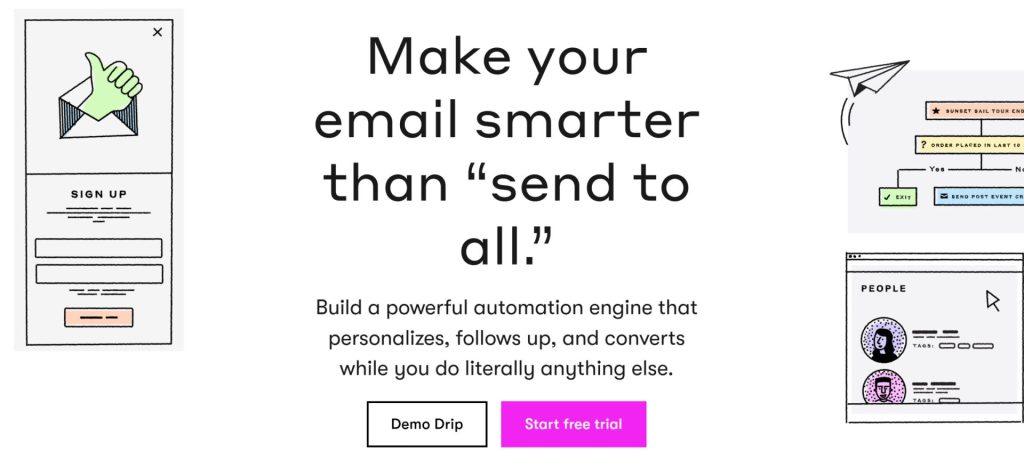
Drip is an ecommerce-focused marketing automation platform with a 4.4 rating on G2. The visual workflow builder is Drip’s strongest feature. All paid plans include every feature with no tier gating. Every tier includes unlimited email sends, dynamic segments, onsite campaigns (pop-ups, bars, embeds), up to 50 workflows, and unlimited sub-accounts.
The WooCommerce integration is official and syncs customer data, order history, product catalog, and cart activity. There is no free plan, just a 14-day free trial with full feature access. At 10,000 contacts, Drip costs $154 per month. Annual billing saves 25%.
- Pricing: $39/mo (2.5K contacts). $89/mo (5K). $154/mo (10K). $449/mo (30K). $1,199/mo (100K).
- Best for: Stores that want a powerful visual workflow builder without paying for tier upgrades to unlock features.
15. Brevo (formerly Sendinblue)
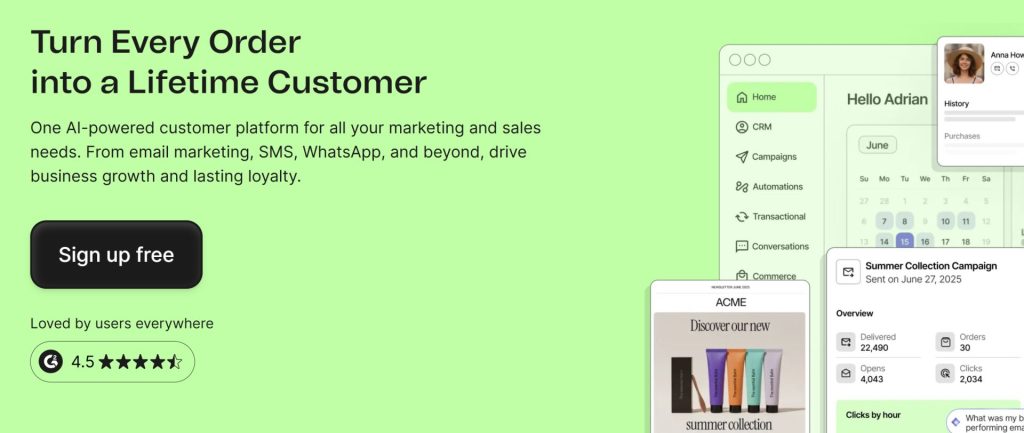
Brevo charges by email volume instead of contact count, so you can store unlimited contacts and only pay for the emails you actually send. It has over 500,000 active business accounts and a 4.4 rating on G2. Email, SMS, WhatsApp, and live chat are all in one platform.
The official WooCommerce plugin syncs customer data, orders, and products in real time. The Professional plan ($499/mo) adds AI segmentation, contact scoring, web push notifications, and product recommendations. The built-in SMTP service handles transactional emails like order confirmations without needing a separate service. One detail: the free plan includes Brevo branding on all emails.
- Pricing: Free (300 emails/day, unlimited contacts). Starter from $9/mo (5K emails). Standard from $18/mo (adds automation). Pro from $499/mo.
- Best for: Budget-conscious stores with large lists that want multi-channel communication without per-contact pricing.

16. Omnisend
Omnisend is an omnichannel marketing automation platform built for ecommerce with a 4.6 rating on G2. It serves over 100,000 ecommerce brands. The platform supports email, SMS, web push notifications, and WhatsApp in a single dashboard. Pre-built automation workflows cover welcome series, abandoned cart recovery, browse abandonment, post-purchase follow-ups, and win-back campaigns.
The official WooCommerce plugin connects your store. The free plan includes 250 contacts and 500 emails per month with all features accessible for testing. Standard plan starts at $16 per month for 500 contacts. The Pro plan at $59/mo for 2,500 contacts includes unlimited emails and SMS credits equal to your plan cost. 24/7 live chat support is included on all paid plans.
- Pricing: Free (250 contacts, 500 emails/mo). Standard from $16/mo (500 contacts). Pro from $59/mo (2.5K contacts, unlimited emails).
- Best for: Ecommerce stores that want omnichannel marketing with ready-to-use automation templates that work out of the box.
17. Metorik
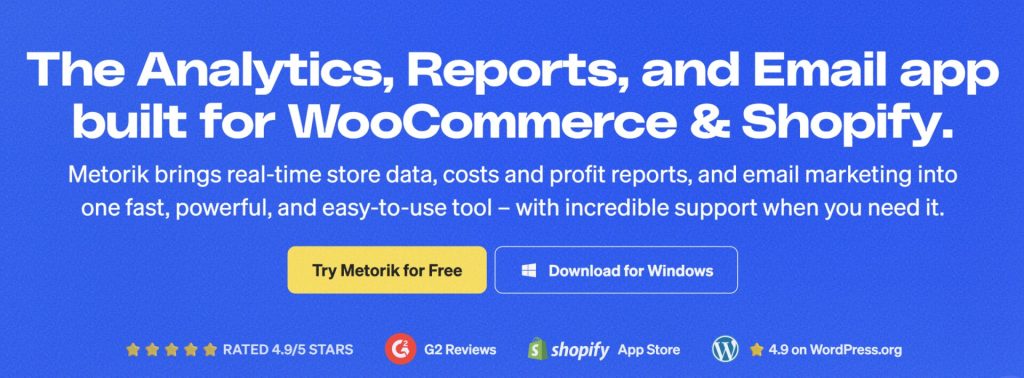
Metorik is an ecommerce analytics and reporting platform built specifically for WooCommerce and Shopify. It has a 4.9 rating on G2 from 159 reviews and over 10,000 stores use it. Metorik includes 75+ pre-built reports covering sales, customers, products, subscriptions, costs, and profit. It also has COGS (Cost of Goods Sold) tracking, 500+ segmentation filters, cohort analysis, and an Engage add-on for sending automated emails.
Pricing is based on monthly order volume, not contact count. Level 1 at $25 per month covers up to 100 orders. Level 2 at $75 per month covers up to 500 orders. All plans include unlimited users. Q1 2026 added a new API, Custom Metrics, Operational Costs tracking, and an AI-powered segment builder called Jarvis.
- Pricing: Level 1 $25/mo (100 orders). Level 2 $75/mo (500 orders). Level 3 $150/mo (2K orders). Level 4 $250/mo (5K orders). Engage add-on costs extra.
- Best for: Data-driven store owners who want detailed analytics, profit tracking, and advanced segmentation. Pair with a separate email tool for campaigns.
Category 3: Middleware and Connector Tools
Middleware tools do not provide CRM features themselves. Instead, they connect your WooCommerce store to dozens of CRM and marketing platforms. These are useful when you already have a CRM but need deeper WordPress integration than the standard plugin offers.
18. WP Fusion
WP Fusion is a WordPress plugin that connects your site to 50+ CRM and marketing automation platforms including HubSpot, ActiveCampaign, Salesforce, and many more. It syncs user data, applies tags, and maps custom fields between WordPress and your CRM. Over 37,000 sites use WP Fusion with a 5-star rating on their site.
The Personal plan at $297 per year covers 1 site with core plugin features. The Plus plan at $427 per year adds Enhanced Ecommerce, Abandoned Cart, and Event Tracking. There are no per-contact limits or API usage caps.
- Pricing: Personal $297/yr (1 site). Plus $427/yr (enhanced features). Professional $647/yr (unlimited sites). Lifetime from $999.
- Best for: Stores that already use a specific CRM and need deep, reliable WordPress integration without switching platforms.

19. Zapier
Zapier is an automation platform that connects 7,000+ apps including WooCommerce and most CRMs. You build Zaps that trigger actions when events happen in WooCommerce, such as creating a Zoho CRM contact when a new order is placed. The official WooCommerce Zapier integration plugin costs $59 per year from the WooCommerce marketplace.
- Pricing: Free (100 tasks/mo, 2-step Zaps). Starter $20/mo (750 tasks). Professional $49/mo (2K tasks). Team $99/mo (50K tasks). Plus WooCommerce plugin $59/yr.
- Best for: Stores that need to connect WooCommerce to a CRM with no direct integration, or need multi-step workflows across multiple apps.
20. Uncanny Automator
Uncanny Automator is a WordPress-native automation plugin that connects your site’s plugins together without needing Zapier or external services. The free version supports basic triggers and actions. The Pro version at $149 per year unlocks unlimited recipes, premium integrations with 30+ plugins and services, and the ability to connect to external CRMs via webhooks.
For WooCommerce, you can trigger automations on purchases, order status changes, and product reviews, then send data to your CRM or email platform.
- Pricing: Free version. Pro from $149/yr (1 site). Agency from $249/yr (unlimited sites).
- Best for: Stores that want to automate WordPress-to-CRM workflows without paying for a separate Zapier subscription.
How to Choose the Right CRM Integration for Your Store
After researching 20 different options, here is how I would pick based on your specific situation. The right WooCommerce CRM integration depends on your budget, your technical comfort, and what you want the CRM to actually do.
- If data privacy is your top concern. Choose a native WordPress plugin like CRMlytics, FluentCRM, or Jetpack CRM. All three run on your server with no external data sync. CRMlytics is free with predictive analytics. FluentCRM has the best automation builder. Jetpack CRM handles invoicing and client portals.
- If your main need is email marketing automation. Start with FluentCRM (self-hosted) or ActiveCampaign (cloud). Both have excellent visual automation builders. MailPoet is a simpler self-hosted alternative with a generous free tier.
- If abandoned carts are costing you money. FunnelKit Automations has a free Lite version with cart recovery triggers. AutomateWoo has the most WooCommerce-specific triggers at 190+. Omnisend is a strong cloud alternative with browse abandonment tracking.
- If you want predictive analytics without enterprise prices. CRMlytics is the only free option that gives you churn prediction and RFM scoring. Klaviyo has similar features but charges per contact.
- If budget is your biggest constraint. CRMlytics and Jetpack CRM are both free at the core level. Brevo per-email pricing saves money for stores with large lists. MailPoet free tier handles 1,000 subscribers with real automation features.
Final Thoughts
The WooCommerce CRM integration space has options at every price point and every complexity level. Choosing the right WooCommerce CRM integration comes down to your specific needs. Native WordPress plugins like FluentCRM, FunnelKit, and CRMlytics give you data ownership and predictable pricing. Cloud CRM connectors like Klaviyo, ActiveCampaign, and HubSpot give you advanced marketing features with ongoing costs. Middleware like WP Fusion and Zapier bridges the gaps when direct integrations do not exist.
My honest advice after going through all 20 tools: do not try to solve every problem with one integration. Many successful stores use two tools together. They use an analytical CRM like CRMlytics to figure out who needs attention, then use an operational CRM like FluentCRM or FunnelKit to send the actual emails. This combination costs a fraction of a single Klaviyo subscription and gives you better targeting because the predictions drive the automation.
If I had to give one piece of advice from all of this research: start with a free tool. Most of the tools here have free tiers or free trials. Install two or three, connect your store data, and see which one you actually want to open every day. The best CRM is the one you actually use.
One more time: I am part of the CRMlytics team. CRMlytics is included in this comparison. That did not affect the pricing data or my opinions about the other 19 tools. I have no affiliate deals with anyone here.